
Ahead of our 30 November Jewellery and Gifts Sale, jewellery specialist, Catrin Jones shares an insight into diamond cutting.
16 November 2022
Diamonds, like many other gemstones, were historically thought to hold powerful talismanic or magical properties and, at various times, have been attributed with the power to impart energy, strength and beauty; to heal the body if held in the mouth while fasting; to cure the spiritual defects of a liar; and to heal chronic cases of bladder disease… In the early centuries in which these beliefs were held, there was little incentive to polish and cut diamonds, since it was in their natural crystal form that the diamonds’ powers could be imparted; in the Indian lapidary work Agastimata, it is written that polishing a diamond on a wheel would cause the diamond to lose its magical properties. The diamonds most commonly found in jewellery from this time are known as ‘point cut’ diamonds, though these diamonds are in fact not ‘cut’ at all, but are simply octahedral crystals, one of the natural crystal forms of diamond.

Left Lot 1015 £4,000 - £5,000 / Right Lot 1152 £6,000 - £8,000
European diamond cutting originated in Venice circa 1330, after Venetian merchants opened trade routes to the East facilitating the entry of diamonds into Europe from India, the only diamond source at the time. The first true diamond cut was a ‘table cut’ diamond and appears in the early 16th century. The table cut was an octahedron with the top point flattened to a square facet, known as the table, and this type of cut remained in favour well into the 17th century.
In the mid-18th century, as the Indian diamond mines were starting to be exhausted, new deposits were found in Brazil which produced a steady supply of diamonds. This supply hugely increased the amount of rough diamond available to the extent that prices dropped by 30%. The increase in material meant that diamonds were more and more accessible; they were no longer reserved for European nobility. The increase in demand in turn powered the growth of the diamond-cutting industry, and this rapid growth led to innovation and progress. It was during this period of innovation that the ‘old mine cut’ diamond was developed, with a cushion[1]shaped outline and a total of 58 facets. Old mine cut diamonds were one of the earliest forms of the ‘brilliant cut’ diamond, so named because of the amount of the ‘brilliance’, or sparkle that the stone has.
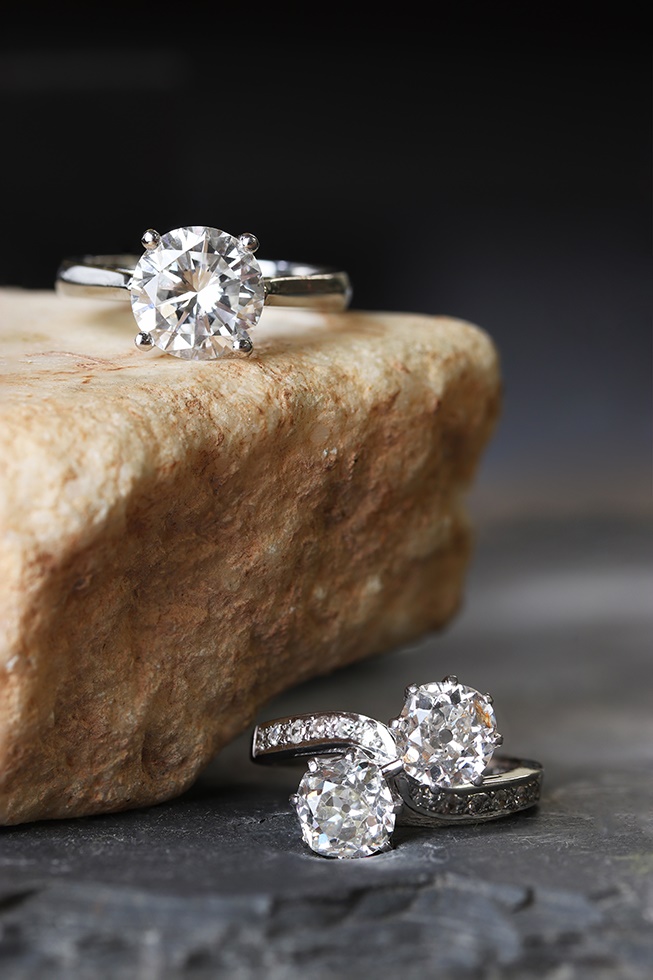
Top Lot 1152 £6,000 - £8,000 / Bottom Lot 1015 £4,000 - £5,000
The 19th century saw the next significant development in diamond cutting, with the invention of the steam-powered bruting machine. Bruting is the process by which the girdle, or outline of the diamond is shaped, by grinding the diamond’s girdle against another diamond, on a specially designed lathe. Before this development, there was no effective way of rounding the outline of the diamond - hence the square or cushion-shaped outline of old mine cut diamonds. After the introduction of the bruting machine, old mine cut diamonds lost popularity, in favour of ‘old European cut’ diamonds, with a round outline and lower crown.
The newly possible round outline laid the groundwork for the ‘modern round brilliant cut’ diamond, developed by Marcel Tolkowsky in the early 20th century. Tolkowsky, an engineer and member of a family of diamond cutters from Poland, worked out the angles and relative sizes needed for each facet of a diamond to produce the greatest scintillation, and published this work in 1919. While there have been minor developments to Tolkowsky’s formula since, the modern round brilliant cut diamond remains the most popular to this day.
To find out more about our 30 November Jewellery and Gifts Sale, please contact Catrin Jones | jewellery@sworder.co.uk
A mesmerising water fountain by Guy Lartigue (1927-2021) is showcased in our upcoming Design sale, to be held on 27 October.
17 August 2026
We are proud to present 'The John Mitchell Collection of Military Horology', starring in our Open House sale, live for browsing and bidding from Tuesday 18 - Monday 24 August.
12 August 2026
We are excited to share one of the highlights from our upcoming November Asian & Islamic Art sale - a Qing Dynasty (1644-1911) Chinese scroll depicting The Peach Blossom Spring.
10 August 2026