Édouard Moyse
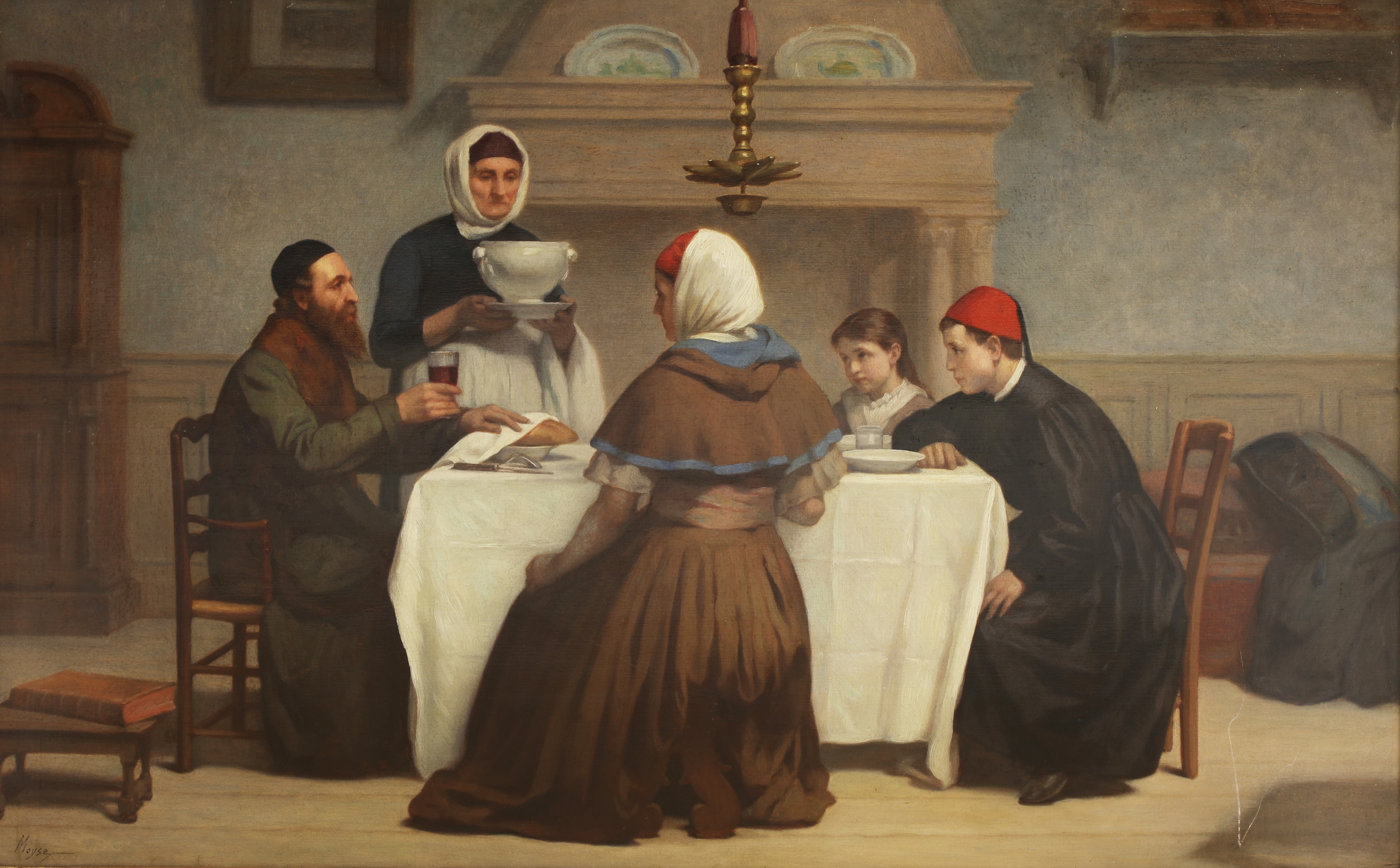
Here we dicuss the brave work of Édouard Moyse (1827-1908) as his piece titled 'La Bénédiction de l'Aïeul' will be up for auction in our Fine Interiors sale in early December. Moyse is considered the first artist in France to regularly depict scenes from Jewish life at a time of great anti-semitism in France where anti-Jewish riots had accompanied the 1848 revolution...
Édouard Moyse
'La Bénédiction de l'Aïeul'
Estimate - £20,000-30,000
Édouard Moyse (1827-1908) is considered the first artist in France to regularly depict scenes from Jewish life. He studied at the École des Beaux-Arts in Paris from a young age and began exhibiting at the Paris Salon as early as 1845.
Moyse chose to paint Jewish life at a time of great anti-semitism in France where anti-Jewish riots had accompanied the 1848 revolution. His pieces often depicted the synagogue, scenes of circumcision or blessings and painful events from Jewish history. Nicknamed ‘the painter of the rabbis’, his critical and commercial success in the genre paved the way for two other late 19th century French painters of Jewish subjects - Jacques Émile Édouard Brandon and Alphonse Lévy.
'La Bénédiction de l'Aïeul' (The Blessing of the Ancestor) depicts the Kiddush, the sanctification/benediction. Five figures inhabit the room - four at the table, one serving soup - with the pater familias preparing a blessing as he rests his hand on the Challa loaf. The oil painting will appear in our Fine Interiors sale this December and is a prime example of Moyse’s highly regarded work.
For more information about this lot, please contact | jamespickup@sworder.co.uk
Recent News
Dino Martens: Murano Maverick
We are excited to bring a particularly rare piece of Murano glass to auction. This daring example of Dino Martens’s work will be offered on Tuesday 13 October in The Glass Sale.
18 September 2026
'Life Isn't Good. It's Excellent'
Here, close friend, art historian and former Senior Curator of Modern British Art at Tate, Andrew Wilson, offers an insight into James Birch’s remarkable collection and the extraordinary life behind it. Having known James since the late 1980s, Andrew has witnessed first-hand his restless curiosity, his friendships with artists and his instinct for the unusual.
15 September 2026
Behind the Lens | Martin Luther King Jr. and Lal Bahadur Shastri
Discover the story behind two rare photographs of Martin Luther King Jr. and Lal Bahadur Shastri, exploring their historic meeting in London, and the significance of the original colour film.
8 September 2026