
During the latter half of the 19th century, North Indian calligraphers based in Delhi were working through a transformative period, as the Mughal Empire’s official patronage waned and British colonial influence expanded.
11 May 2026
VIEW LOT REQUEST A VALUATION CONTACT A SPECIALIST
The city initially experienced a brief cultural revival under the last Mughal emperor, Bahadur Shah Zafar (1775–1862), a mystic, poet, and accomplished calligrapher. During his reign, Bahadur Shah fostered a vibrant court culture and a short-lived resurgence of the arts and literature. He was a patron of celebrated poets such as Mirza Ghalib and Meer Zauq and was himself highly skilled in both poetry and calligraphy.
Following the formal end of Mughal rule, many calligraphers transitioned from royal commissions to working in Old Delhi’s historic bazaars, such as the Urdu Bazaar, often competing for patrons in a changing cultural economy. At the same time, the rise of lithography and photography also changed the production of manuscripts, enabling mass reproduction and reducing the market value of hand-copied works. To survive, many master calligraphers became katibs (a writer or scribe) for lithographic presses, allowing their work to appear in newspapers, Qur’ans, and other printed texts but diminishing the status of their calligraphy as unique, authorial creations.
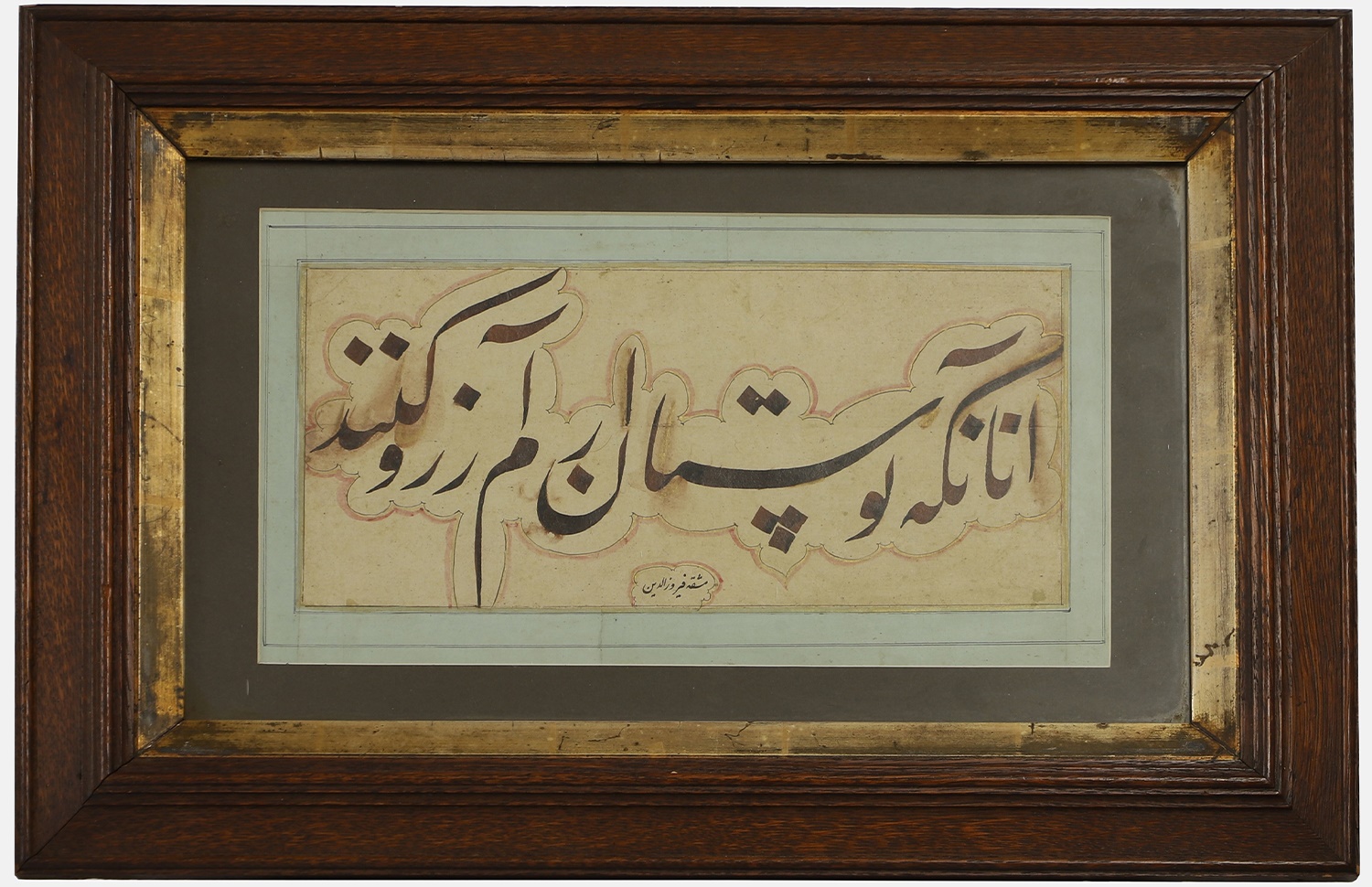
A Hindustani single line of 'nasta’liq' poetry in sepia ink, circa 1860s, Northern India, Delhi (£300-500)
Although the Mughals were no longer great patrons of the arts as they once were, the British officials stationed in India soon replaced them as active buyers and keen collectors of the local crafts. As an example, Colonel George William Hamilton (1807–1868), a British officer who served in India from 1823 to 1867 and was appointed Commissioner of Delhi in 1862, compiled one of the most complete examples of post-Mughal Hindustani calligraphy albums, now preserved in the Wigan Archive near Manchester. After his death, the British Museum purchased 352 manuscripts from his widow, Charlotte Logie Hamilton (1817-1893). These volumes now form a significant portion of the British Library’s South Asian manuscript holdings.
Other similar Hindustani calligraphic albums, closely related to the style of poetry, calligraphy and signature of lot 303 in our Asian & Islamic Art sale, survive today in many public British collections, like the John Rylands Research Institute and Library in Manchester.
asianart@sworder.co.uk | 01279 817778
We are excited to bring a particularly rare piece of Murano glass to auction. This daring example of Dino Martens’s work will be offered on Tuesday 13 October in The Glass Sale.
18 September 2026
Here, close friend, art historian and former Senior Curator of Modern British Art at Tate, Andrew Wilson, offers an insight into James Birch’s remarkable collection and the extraordinary life behind it. Having known James since the late 1980s, Andrew has witnessed first-hand his restless curiosity, his friendships with artists and his instinct for the unusual.
15 September 2026
Discover the story behind two rare photographs of Martin Luther King Jr. and Lal Bahadur Shastri, exploring their historic meeting in London, and the significance of the original colour film.
8 September 2026