
We are pleased to offer a ceramic work by Pablo Picasso in our upcoming Design auction, taking place on Tuesday 27 January.
18 December 2025
BROWSE THE CATALOGUE REQUEST A VALUATION CONTACT A SPECIALIST
Pablo Picasso’s ceramics embody a remarkable fusion of tradition and modernity, revealing the artist’s ability to bridge ancient craftsmanship with the avant-garde movements that defined his career. His foray into pottery began in 1947, when he was invited to collaborate with the Madoura pottery studio in Vallauris, a village in south-eastern France. Having visited the studio the previous year, Picasso was immediately captivated by the tactile and utilitarian nature of ceramics. He recognised that while abstract painting might alienate some viewers, a finely crafted and beautifully decorated vessel could appeal to a broader audience. Pottery, for him, offered a new way to merge artistry and function - transforming everyday objects into sculptural forms of expression.
Picasso’s collaboration with the artisans at Vallauris proved both prolific and transformative. Over the course of nearly twenty-five years, until 1971, he produced 633 different ceramic editions, along with many variants and unique pieces derived from these originals. His early experiments focused on simple decorated plates and bowls, but he went on to push the boundaries of form and imagination. Traditional vessels gave way to abstract, organic and zoomorphic creations that blurred the line between form and function. Once Picasso completed a prototype, the skilled ceramicists at Madoura would produce a limited series based on his design, ensuring that each piece carried both the artist’s vision and the studio’s craftsmanship.
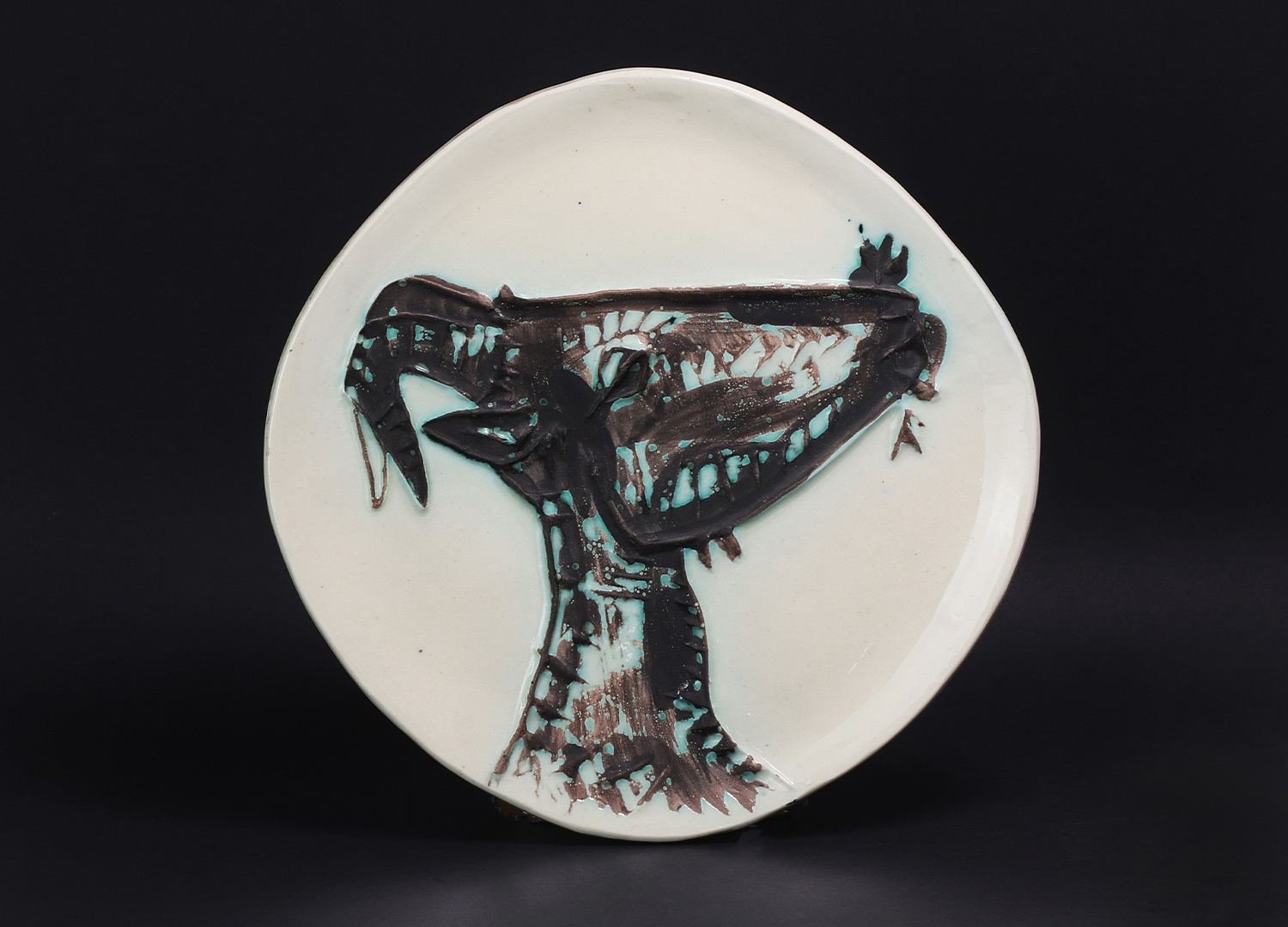
▲ Pablo Picasso (Spanish, 1881-1973), A 'tête de chèvre de profil' (AR110) plate (£3,000-5,000)
A defining feature of Picasso’s ceramic work lies in its rich and varied iconography. The imagery spans an extraordinary range of subjects - from bullfighting scenes and mythological creatures to fish, owls, goats and human faces. Many of these motifs hark back to Picasso’s Andalusian roots, recalling the vivid colours and cultural symbols of his youth in Málaga and Barcelona. On his sun-drenched Mediterranean plates, one can find depictions of the corrida, radiant suns, birds in flight, and expressive, often tormented faces. Through these works, Picasso revisited the landscapes and memories of his early life, channelling a deep sense of nostalgia and vitality. His ceramics exude a Mediterranean joie de vivre combining playful spontaneity with masterful technique.
Ancient influences were equally important to Picasso’s ceramic process. Inspired by Cypriot and Hispano-Moorish pottery, he borrowed from their decorative traditions while infusing them with his distinctly modern sensibility. He often adorned amphora-like forms with female faces or bullfighting scenes, and, in a nod to historical precedent, decorated both sides of his plates. In doing so, Picasso reimagined the ancient craft, transforming it into a living dialogue between past and present.
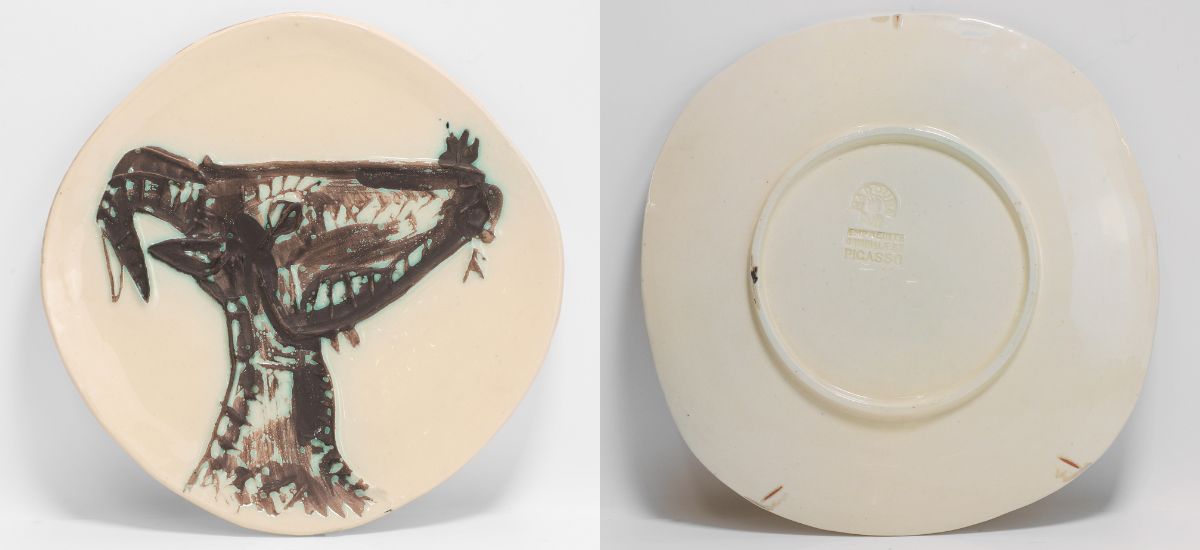
▲ Pablo Picasso (Spanish, 1881-1973), A 'tête de chèvre de profil' (AR110) plate (£3,000-5,000)
Among his recurring subjects, the goat holds a special place. During his years in Vallauris in the late 1940s and early 1950s, goats wandered freely through the village streets and sunlit hillsides, becoming a familiar part of his surroundings. To Picasso, the goat symbolised independence, resilience and earthy vitality - qualities that mirrored his own temperament. His renderings of goats, whether in profile or sculptural form, elevate the humble animal to an emblem of creative freedom.
Today, Picasso’s ceramics are among the most sought-after works of his later career, celebrated for their inventiveness and enduring charm. They reside in major museums and private collections worldwide, and continue to attract critical and scholarly attention in literature and exhibitions. We are delighted to include Tête de chèvre de profil (AR 110) in our January Design auction, offered with a pre-sale estimate of £3,000-£5,000 - a testament to the timeless appeal of Picasso’s artistry in clay.

design@sworder.co.uk | 01279 817778

Join us as we look back at some of the most notable highlights from our 2025 sales and celebrate another excellent year.
18 December 2025
Founder of The Professional Organiser, Cornelia De Uphaugh, shares her process and philosophy through a series of interview questions.
18 December 2025
From all at Sworders, we wish you a very Merry Christmas and a Happy New Year! We would like to sincerely thank you for your ongoing support throughout 2025, we look forward to seeing you in 2026.
18 December 2025