
An exciting selection of Peter Collingwood’s work is showcased in our upcoming Design sale, to be held on 14 July.
26 June 2026
BROWSE THE CATALOGUE REQUEST A VALUATION CONTACT A SPECIALIST
When we think of the art of the woven textile, we may imagine opulent works crafted in historical centres of production such as Flanders or Arras. One might cast their mind to the famed ‘Dame à la licorne’ tapestries located in the Musée de Cluny, Paris or The Sistine Chapel tapestries after Raphel’s cartoons. Modern examples from South-African born artist Miriam Sacks employed what she called ‘painting with wool’, however, they remained rooted in what we think of as more ‘traditional’ techniques. It wasn’t until the 1950s when the thread of the woven world was unravelled by a pioneering British artist weaver called Peter Collingwood.
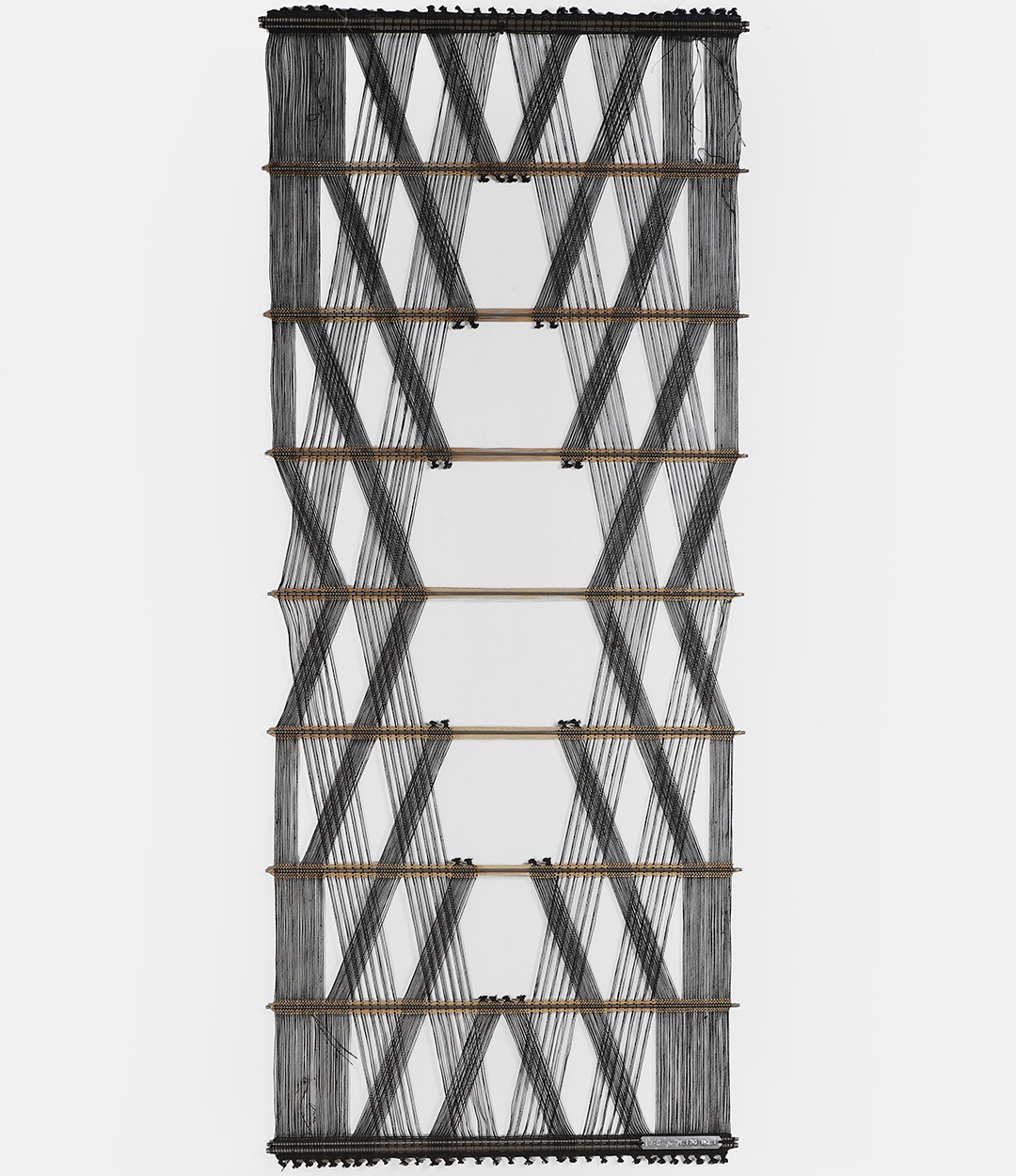
▲ Peter Collingwood (British, 1922-2008), 'M170', No.1 (£3,000-5,000)
Collingwood was born in 1922 in Marylebone, London to a Classics scholar and a professor of physiology. His father died when he was just 12 years old and he was educated at a preparatory school for the sons of doctors. From there, he studied at Epsom College, Surrey and then eventually St Mary’s Hospital. Although his father had been a medical professional, Peter soon realised this was not to be his destiny. During his National Service in the Royal Army Medical Corps and the Red Cross in Jordan, he had made a basic loom out of two deck chairs and produced scarves for officers’ wives. Whilst on his travels around the world, he was gifted a Bedouin tent-hanging which was one of his prized possessions and a life-long fascination with textile structure was born. Throughout his life, he would acquire numerous objects that formed his ‘Ethnographic Collection’ that regularly influenced his practise, and which is now held in the collection of the Crafts Study Centre.
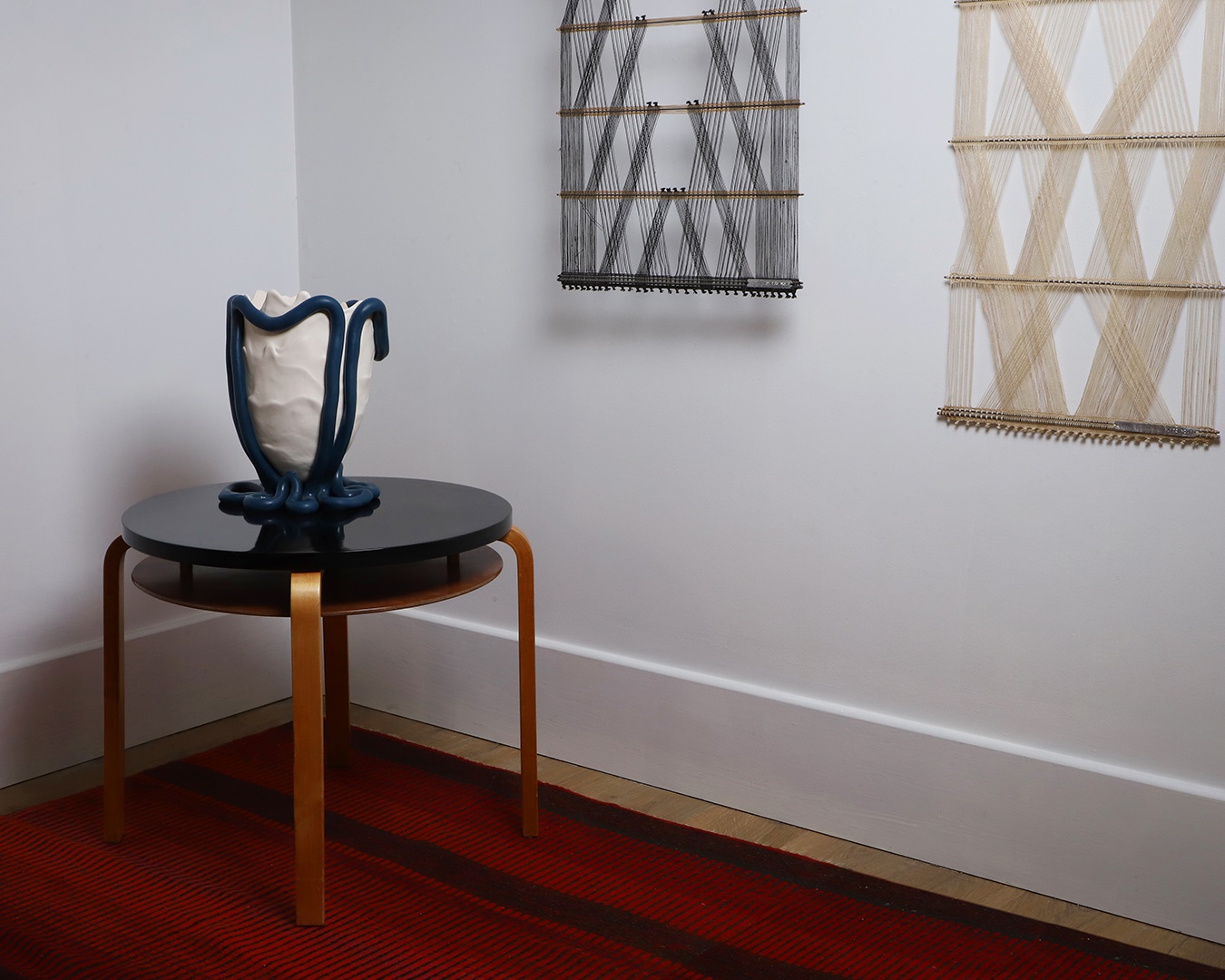
▲ Peter Collingwood (British, 1922-2008): a rug (£500-800) and wall hangings [left - 'M170', No.1 (£3,000-5,000) & right - 'M172', No. 1 (£4,000-6,000)] | Also featured: Alvar Aalto (Finnish, 1898-1976), a coffee table (£1,000-1,500) and Gaetano Pesce (Italian, 1939-2024) for Fish Design, an 'Indian Summer' vase (£500-700)
Upon returning to England, Collingwood spent six months in Ditchling, East Sussex, in the workshop of one of the well-known weavers at that time, Ethel Mairet. After this, he then worked for two other notable weavers, Barbara Sawyer and Alastair Morton, who would eventually go on to become the artistic director of Edinburgh Weavers. The pair fostered a creative freedom within Collingwood, and he embarked on a life full of experimentation and innovation. By 1952, he established a workshop in Archway, north London. Within this space, he built his own equipment and wove rugs that he sold to Liberty and Heal’s. He also exhibited at organisations such as the Red Rose Guild and the Arts and Crafts Exhibition Society, as well as writing articles for the Journal of the Association of Guilds of Weavers, Spinners and Dyers. These early written works would eventually spur Collingwood on to publish five profoundly influential books, with his first and arguably best-known being Techniques of Rug Weaving (1968) and his personal favourite which provides the most insight into his methods - The Maker's Hand (1988).1
In 1957 the Digswell Arts Trust in Hertfordshire was set up by educationalist Henry Morris. The following year, Collingwood was invited to become one of the institution’s first fellows. During his tenure at Digswell, he met renowned potter Hans Coper, who he would eventually participate in a joint exhibition with at the V&A in 1969. Morris introduced Collingwood to several high-level contacts including architects and planners, and he received numerous substantial commissions from the likes of Gordon Russell as well as for the interiors of Shell Tower. It was at this time he began experimenting with rugs and developed a technique he dubbed ‘shaft switching’, this allowed him to adapt the loom in such a way which enabled him to weave his designs in a quicker fashion as opposed to more laborious methods. He had also worked out a way of weaving the weft at an angle, called ‘anglefells’.2
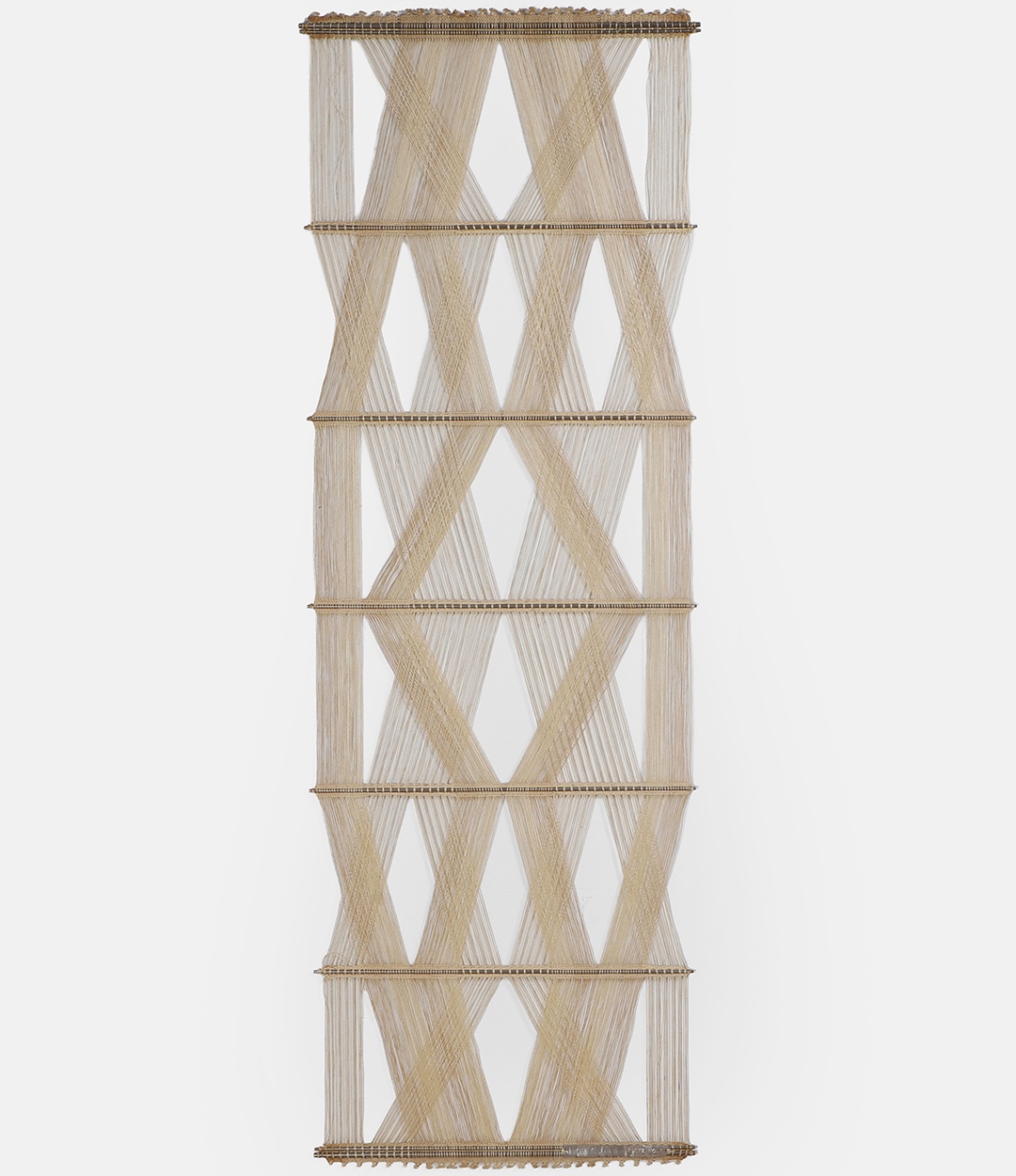
▲ Peter Collingwood (British, 1922-2008), 'M172', No. 1 (£4,000-6,000)
These new discoveries culminated in Collingwood developing what he was most well-known for, his Macrogauze wall hangings. These works allowed the warps to cross each other and move sideways, giving the illusion of layered space, almost bridging the gap between flat work and sculpture. Collingwood would eventually move further away from the wall and extend them into three-dimensional pieces that could be observed in the round. Over a 30-year period, Collingwood created over 250 Macrogauze works, completely changing the fabric of what it means to be a weaver. His competency and technical skill have been an inspiration to many and continue to be.
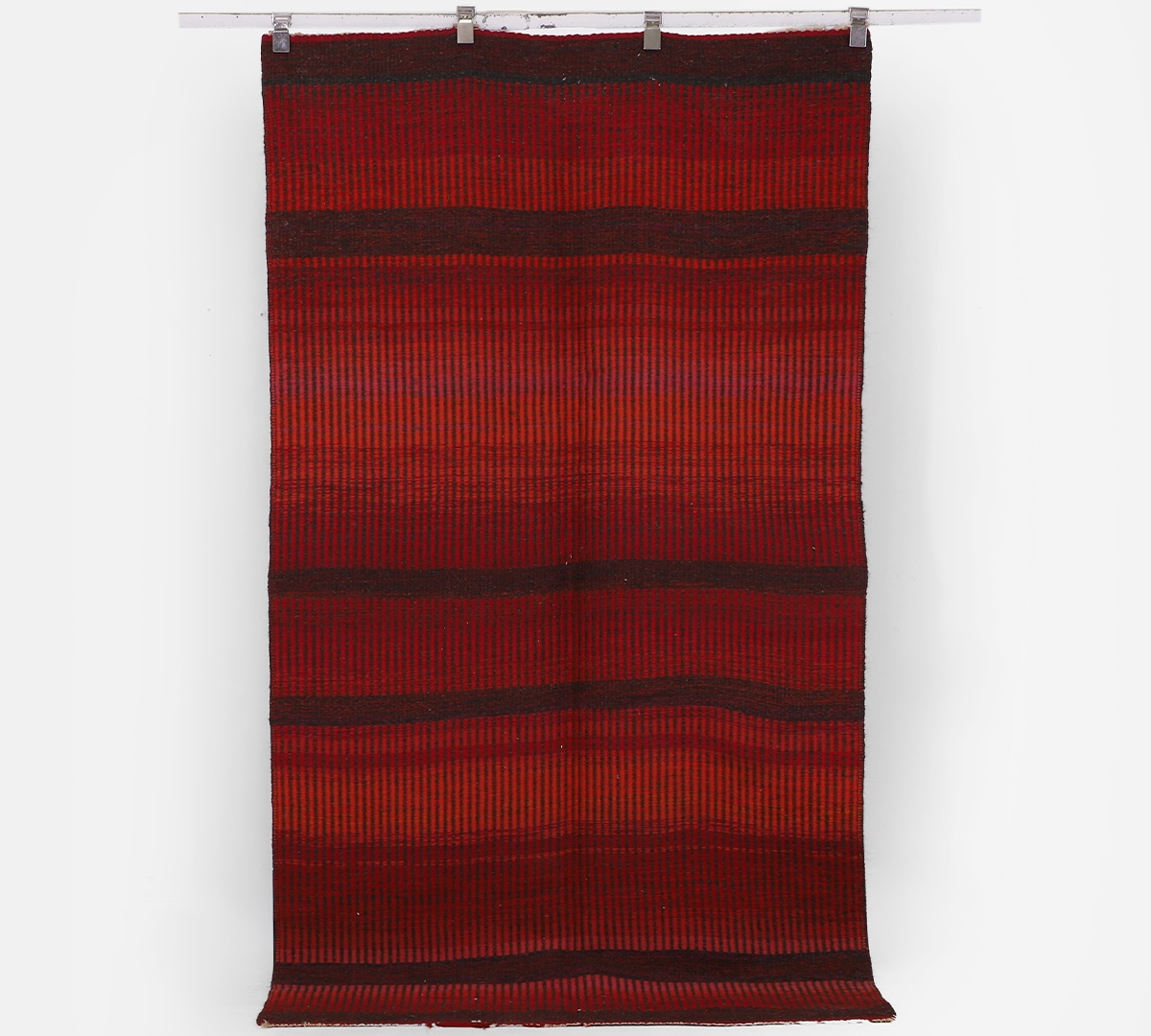
▲ Peter Collingwood (British, 1922-2008), a rug (£500-800)
One such figure who reveres Collingwood’s work is the British fashion designer Margaret Howell. Her namesake label hosted an exhibition of Collingwood’s wall hangings last year at her Wigmore Street store in London. The exhibition was realised through various private loans, Crafts Council and Crafts Study Centre, University for the Creative Arts, as well as Collingwood’s children Jason and Rachel.3 The store featured a number of Macrogauze pieces displayed amongst the brand’s clothing, and the imagery from this display formed the content for the 2026 Margaret Howell printed calendar. Both Howell and Collingwood posses a passion for form, fabric structure and craft, so it is no wonder their worlds collided.
Over his nearly 60-year pursuit in redefining the medium of woven textiles, Peter Collingwood’s work remains as timeless and daring as ever, still managing to push boundaries and challenge the technical proficiency of his chosen discipline. We are proud to include a selection of Peter Collingwood’s work in our 14 July Design sale.
1Anonymous, https://www.petercollingwoodtextiles.com/about. Last accessed May 5 2026.
2Anonymous, https://www.petercollingwoodtextiles.com/about. Last accessed May 5 2026.
3Anonymous, https://www.margarethowell.co.uk/pages/peter-collingwood-macrogauze-wall-hangings?srsltid=AfmBOopFf0w7q5Leqo5FAyAlNgowJlBPUSkFzkvoqIWe5ct8dZRVYm1s. Last accessed May 5 2026.

design@sworder.co.uk | 01279 817778
Sworders are delighted to be presenting contents from the personal collection of the celebrated art collector Doris Lockhart Saatchi in our autumn auctions.
24 September 2026
A collection of Georgian silver flatware offered in our 22-28 September Open House sale provides a tangible link to one of the most memorable figures in the history of Eton College: Dr John Keate, Headmaster from 1809 to 1834.
23 September 2026
Our 13 October auction, The Glass Sale, presents a fantastic private collection of John Hutton works.
23 September 2026