
In anticipation of our upcoming auction 'The Glass Sale', we shine a spotlight on René Lalique and his mastery of moulded glass.
13 February 2026
REQUEST A VALUATION BROWSE THE CATALOGUE CONTACT A SPECIALIST
Few figures are as central to the story of Art Deco glass as René Lalique, whose career charts a remarkable journey from jewellery to glass, and from intimate objects to works of architectural ambition. Lalique began his professional life as a jeweller, training under Louis Aucoc and working with prestigious houses including Cartier and Boucheron by the mid-1880s. His early designs, rooted in the flowing lines and natural motifs of Art Nouveau, quickly established his reputation as one of the leading creative figures of his generation.
During this period Lalique began to experiment increasingly with glass by incorporating it into his jewellery designs. A pivotal moment came through his collaboration with the perfumer François Coty, for whom Lalique designed labels and scent bottles. Despite the early examples being manufactured by the Legras glassworks, Lalique took control of his own glass production when he purchased the Combs-la-Ville glassworks in 1913.
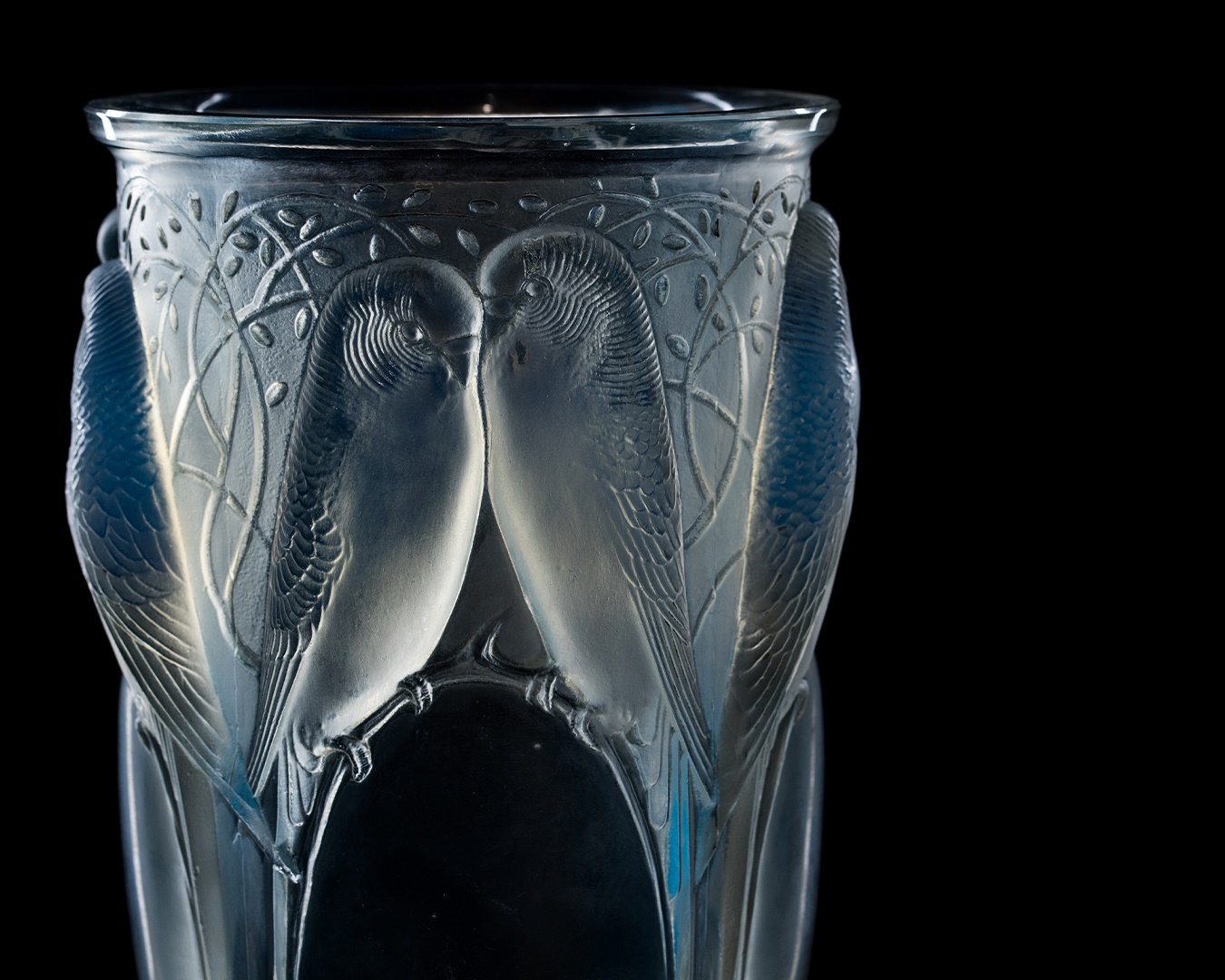
René Lalique (French, 1860-1945), a 'Ceylan' vase (£600-800)
Lalique’s true mastery lay in moulded glass. From his earliest cire perdue experiments - a lost-wax moulding process producing effectively unique objects - to the sophisticated commercial moulding of the interwar years, he redefined what moulded glass could be. The introduction of demi-crystal, containing approximately 12% lead, proved crucial. Though technically a lesser material than full lead crystal, its muted tones, greater softness and gentle diffusion of light made it an ideal medium for Lalique’s designs. Nowhere is this more evident than in his opalescent glass, whose milky luminosity was achieved through carefully controlled additions of arsenic oxide, stannic oxide and fluorine.
By the early 1920s, production at Lalique’s new Wingen-sur-Moder glassworks enabled increasingly complex moulds and more streamlined techniques. Press moulding, introduced at this stage, allowed molten glass to be forced into metal moulds by a plunger, producing crisp external relief while maintaining a smooth interior surface. This balance of efficiency and refinement underpinned many of Lalique’s most enduring designs.
Lalique’s prominence reached its height at the 1925 l'Exposition Internationale des Arts Décoratifs et Industriels Modernes in Paris. He designed his own pavilion and created the monumental Les Sources de France fountain – a striking demonstration of moulded glass at architectural scale. These achievements confirmed moulded glass not as a secondary art, but as a medium capable of luxury, innovation and spectacle.
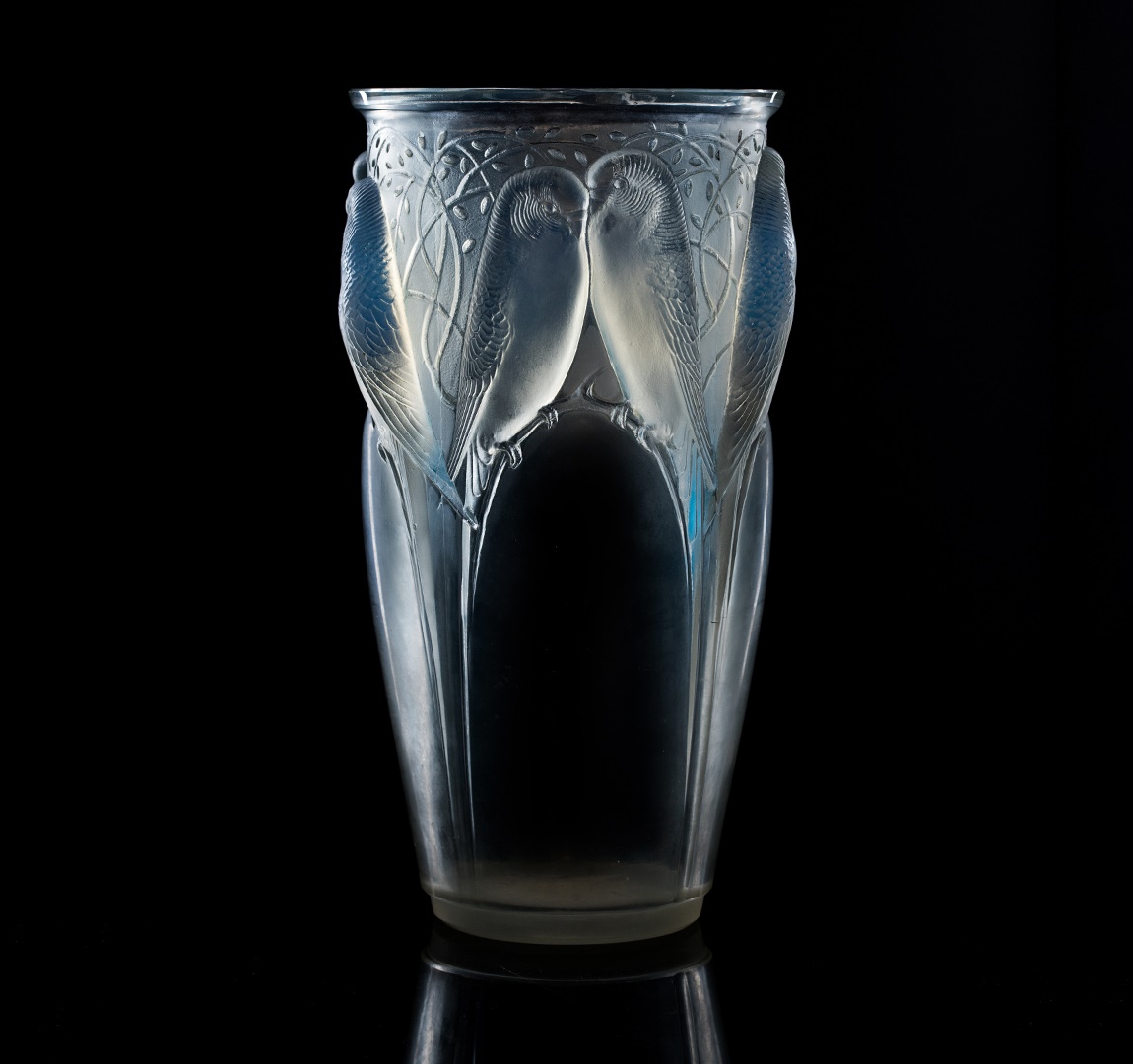
René Lalique (French, 1860-1945), a 'Ceylan' vase (£600-800)
It is within this context that the Ceylan vase should be understood. Produced during Lalique’s interwar period, it brings together many of the defining characteristics of his glass. Decorated with parakeets, a motif consistent with his long-standing use of natural forms, the vase demonstrates his control of moulded glass and relief decoration. Executed in opalescent demi-crystal, it exemplifies the softly diffused surface effects that had become central to his work by the mid-1920s. Originally designed in 1924, the vase was displayed at the 1925 exhibition in Paris, cementing its status as an icon of Art Deco glass.
We are pleased to offer this example in The Glass Sale, a specialist auction showcasing glass across a wide range of periods and techniques. Within this setting, the Ceylan vase stands as a clear expression of Lalique’s achievement in moulded glass, and displays the Art Deco period at its most confident.

alexfroggatt@sworder.co.uk | 01279 817778
Our first Jewellery and Luxury sale of the year will feature a collection of Mr. Fish garments and other late 1960s clothing.
13 April 2026
Sworders are delighted to present a significant collection of Gucci items in our upcoming auction, taking place on Wednesday 29 April.
13 April 2026
EA Festival - one of the East of England’s leading ideas and literary festivals - presents Stories of Guinness, a one-day cultural festival, inspired by the history of the Guinness family, at Elveden Hall, Suffolk, on Saturday 13 June. Bringing together a carefully curated programme of talks, music, art and tours, the festival explores the enduring resonance of dynastic history in the modern world.
13 April 2026