
We are proud to announce that The HALO Trust has been selected as our Charity of the Year for 2026, and throughout the year, we’ll be supporting HALO’s lifesaving work through fundraising and education, whilst championing their mission.
14 January 2025
We’re proud to announce The HALO Trust as our Charity of the Year 2026. Throughout the year, we’ll be supporting HALO’s lifesaving work clearing landmines and explosive remnants of war, helping communities rebuild and thrive. We’ll be fundraising, learning about, and amplifying their mission - beginning with the powerful piece below, by Rob Thomson, Chief Strategy Officer at The HALO Trust.
A DAY ON THE MINEFIELD
By Rob Thomson, Chief Strategy Officer, The HALO Trust
My day starts at 4.50 am under an African night sky bright with stars. Dawn is still an hour away. The HALO camp, one of three along Zimbabwe’s border with Mozambique, begins to stir.
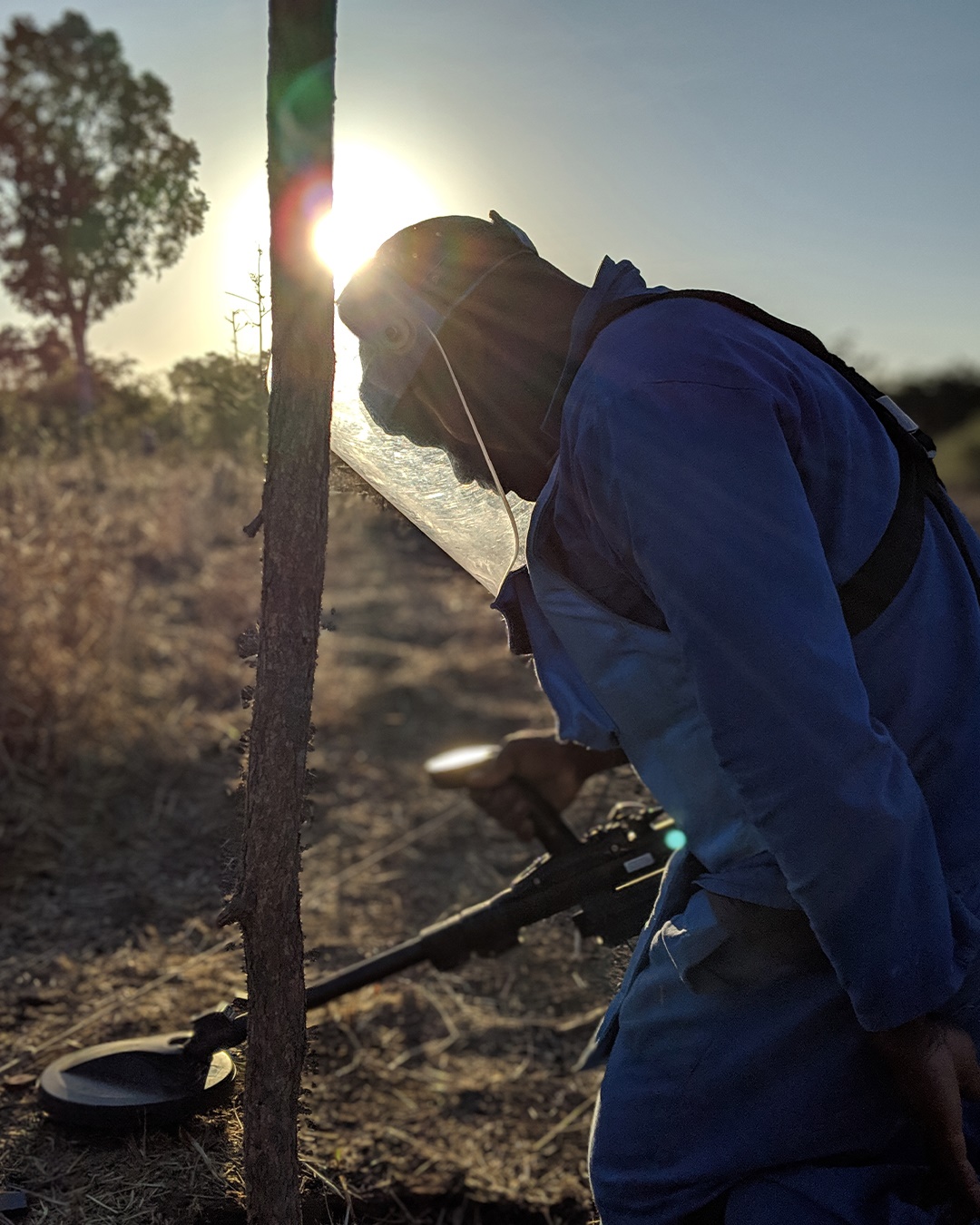
Seventy deminers - local men and women trained by HALO - line up for morning parade in the half light. After a short briefing and a prayer in Shona, they climb into trucks, clutching fresh loaves of bread from the camp bakery. As the sun rises, we head for the minefields. Clad in bright blue body armour and bumping along a dirt road through the bush, this feels very different from my usual commute.
Why are we here? Nearly 50 years after Zimbabwe’s Liberation War, hundreds of thousands of lethal weapons remain buried beneath this soil. Landmines, many small enough to fit in a child’s hand, have killed or injured more than 1,500 civilians and over 120,000 cattle. Yet their most insidious impact is fear and lost opportunity. Fields cannot be farmed. Homes, clinics and roads cannot be built. People are unable to move freely or trade. Mothers worry as their children walk to school. For generations born long after the fighting stopped, the violence of the past still constrains daily life.
That’s why thousands of men and women from war-torn communities around the world dedicate themselves to clearing their countries of landmines as part of the HALO team.
Credit: The HALO Trust
Founded in Afghanistan in 1988 by two former British soldiers, HALO now operates in 32 conflict-affected and post-conflict countries, with a workforce of over 8,500 people. Around 90 percent are recruited locally and undergo intensive training to become life-saving professionals.
The work is not for the faint-hearted. After pulling on my safety visor, I watch detectors sweep the ground to locate mines, which are then carefully excavated by hand. Each device is soaked for 30 minutes before being detonated. Every action follows proven, rigorous procedures. In this minefield alone, the team finds an average of 35 deadly devices a day - each capable of claiming a life or a limb. Sharp minds and steady hands are essential.
By midday, the sun is high, my kit feels heavy, and I’m ready for a break. For my colleagues, it’s another day at the office. They will be back out tomorrow, and the day after. And the day after that. Around five more years of work lie ahead to make Zimbabwe mine-free. HALO plans to stay until that day comes.
While a safer future is finally within reach here, globally around two billion people - a quarter of the world’s population - now live in active conflict zones. Ukraine has seen an estimated two million mines laid since 2022. In Syria, hundreds of thousands of unexploded bombs litter towns and cities. In Afghanistan, approximately 40 children are killed or severely injured every month while scavenging for scrap metal to support their families.
HALO is rising to the challenge. New technology - like drones, robotics, advanced detectors and AI - is making demining faster and safer. Our goal is to triple the rate at which we return land to communities by 2030.
But at its heart, this work depends on human courage and commitment. The true measure of our success is in lives rebuilt, battlefields transformed into playgrounds and grazing land, in new job opportunities, and in restored feelings of security and hope. In Zimbabwe’s border villages, school enrolment surged once children no longer had to walk through a minefield each day - one primary school grew from just 20 to over 120 students. That transformation is what drives every member of the HALO team.
With Sworders’ support, we can bring that brighter future a little closer. Thank you for helping us make a difference.
To find out more about the life-saving work of The HALO Trust and become part of building a safer, mine-free world, please visit www.halotrust.org

Building on the success of the first event held in partnership with Britten Pears Arts in autumn 2025, Sworders’ team of specialists will return to Snape Maltings on Wednesday 11 February for the next in its series of Art & Antiques Valuation Days.
19 January 2025
Our upcoming Design auction offers carefully crafted pieces by designers and brands that have collaborated to create distinctive, high‑quality furniture, such as Heal's and Fritz Hansen.
15 January 2026
We are proud to announce that The HALO Trust has been selected as our Charity of the Year for 2026, and throughout the year, we’ll be supporting HALO’s lifesaving work through fundraising and education, whilst championing their mission.
14 January 2025