
We are proud to feature some excellent plywood furniture in our 27 January Design auction, by designers including Alvar Aalto, Gerald Summers and Saburo Inui.
11 December 2025
VIEW COLLECTION REQUEST A VALUATION CONTACT A SPECIALIST
Peeling back the veneers of the history of plywood furniture is almost as complex as the multiple layers of wood it uses to craft such pieces. Going back as far as the Ancient Egyptians, humans have known about gluing thin sheets of wood to make strong, functional furniture and decorative objects. However, it took until 1837 for an American named Isaac Cole to patent it. He discovered the technique of bending plywood and created a chair with glue-laminated wooden strips.1 Cole may have patented this technique, but a forerunner named Michael Thonet, a German Austrian cabinetmaker, was already in the throws of experimenting with plywood by the 1830s. These early designs were only two dimensional and it was only some time later that he started to trial three dimensional pieces on solid wood. By 1931, the company Gebrüder Thonet had unveiled its first ever cantilever chair, the model S43. Designer Mart Stam managed to make the chair more comfortable and refined with wooden details in bent plywood without using any upholstery.
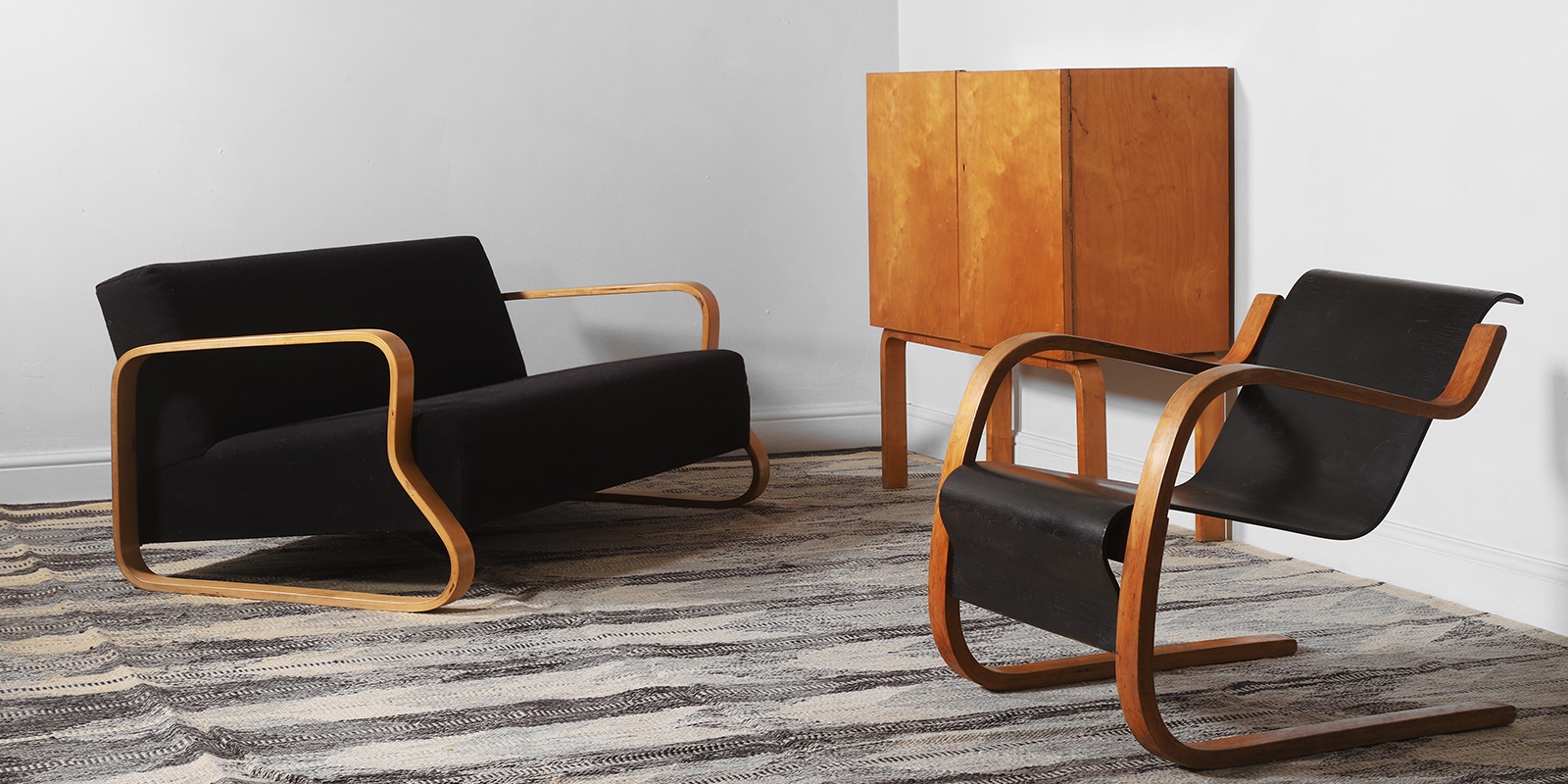
Alvar Aalto (Finnish, 1898-1976) | Left: A model '544' sofa (£3,000-5,000), Middle: A model '250' cabinet (£1,500-2,500), Right: A model '31' armchair (£4,000-6,000)
Traditionally plywood was seen as an industrial material and in the 1930s, synthetic glue was created and added to the production method to waterproof the layers. This then meant plywood could be used outside. German company DKW introduced this idea into their vehicles, crafting flat and moulded plywood for the bodies of their cars.
Arguably, plywood furniture reached its zenith in the 1920s and 30s with modernist architects exploiting its uses, such as the ability to be shaped into curved forms. The Finnish designer, Alvar Aalto, created an armchair called ‘Paimio’ in 1932 which was named after the Paimio Tuberculosis Sanitorium in Finland. The seat was light and thin and suspended between two moulded plywood frames. A year later, he presented a stacking stool called the ‘Model 60’ at a Finish design exhibition titled ‘Wood Only’ at Fortnum & Mason in London.2 Along with his wife Aino Aalto, Maire Gullichsen and Nils-Gustav-Hahl, the company Artek was founded in 1935 and took the world of furniture design by storm, irrevocably changing its trajectory. Aalto’s influence is still relevant today, with the likes of cult streetwear brands such as Supreme collaborating with Artek in 2017 and offering contemporary takes on the ‘Model 60’ stool, and the ‘400 Tank chair’ upholstered in a red Robert Indiana inspired fabric.3 Even Britain had been intoxicated with a passion for plywood, with the likes of Gerald Summers, Robin Day and Jack Pritchard all experimenting with layered veneers of wood.
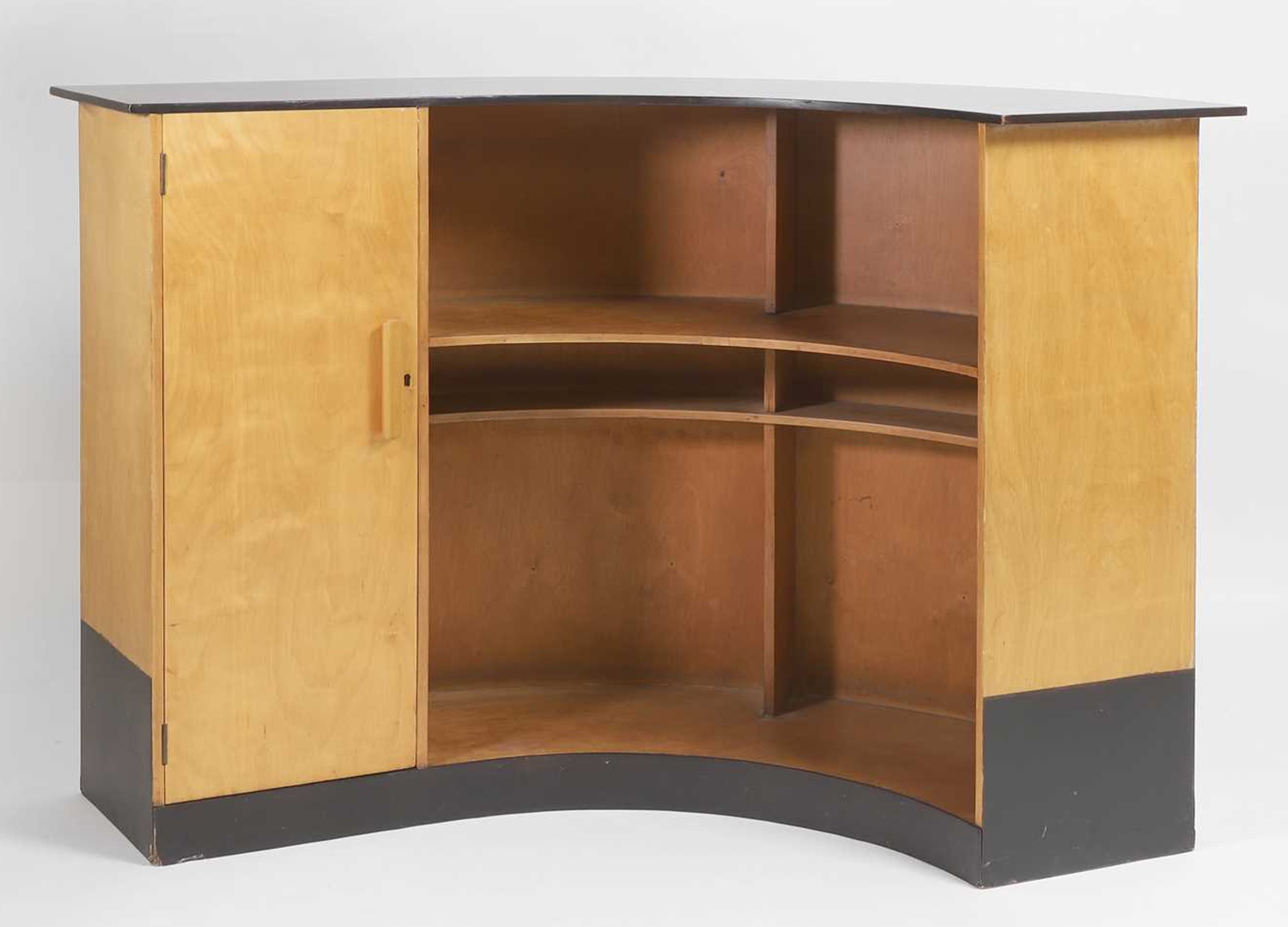
Gerald Summers (1899-1967) for Makers of Simple Furniture, A cocktail bar (£2,000-3,000)
Alvar Aalto may have put plywood on the map, however as time marched on, international designers started to push the envelope of what was possible in plywood. Americans such Ray and Charles Eames and George Nelson were manufacturing creations for Herman Miller. The iconic Eames Lounge chair was introduced in 1956, crafted from moulded plywood and leather - the first time the pair created something for the high-end market. The chair has been remixed in several guises over the years, but the plywood shell has always been a constant and conscious feature.
The layered technique even reached Asia, with Japan’s Saburo Inui and Junzo Sakakura exploring even more unusual methods of using plywood. Saburo Inui had started his career during the Second World War and worked for the Industrial Arts Institute alongside the newly formed company Tendo Mokko to produce wooden ammunition boxes and decoy planes for the Japanese Military using moulded plywood. However, in 1956 a turning point came for Tendo Mokko: designer Yanagi Sori revealed the ‘Butterfly Stool’, following two years of development. He was fascinated with employing the plywood technique but ultimately could not find a factory that could reproduce the delicate shapes of the prototype and turned to Inui for help. Yanagi Sori retrospectively said, "If it weren't for Inui Saburo, I wouldn't have been able to realize the Butterfly Stool."4 By 1959 Saburo Inui had released the ‘Zataku’ low table and the ‘Ply’ chair a year later, with the former winning awards.

Saburo Inui (Japanese, 1911-1991), A 'Zataku' table (£600-800)
A utilitarian material, plywood has defined the look of modern furniture for decades and continues to do so. The fusion of industrial usage coupled with stylish and progressive design sensibilities has contributed to the popularity of plywood. It is an accessible medium that’s not only functional but elegant, and we are delighted to feature several examples in our upcoming Design auction on 27 January.
1 Peter H. Christensen. Prior Art Patents and the Nature of Invention in Architecture. MIT Press. 2024.
2 Charlotte Luxford. “A Brief History of Alvar Aalto’s Stool 60”. Culture Trip. March 20 2017. https://theculturetrip.com/europe/united-kingdom/england/london/articles/a-brief-history-of-alvar-aaltos-stool-60
3 Alice Morby. Supreme covers Alvar Aalto’s iconic 400 Tank armchair in “f*ck” fabric. Deezen. August 15 2017. https://www.dezeen.com/2017/08/15/supreme-launches-special-edition-alvar-aalto-tank-400-armchair-furniture-design/
4 Anonymous, ‘Inui, Saburo’, in arts of Japan. Last accessed December 9 2025.

design@sworder.co.uk | 01279 817778
We are delighted to offer the extensive archive of silversmith A. E. Jones in our next Open House sale, live for bidding from Tuesday 3 - Monday 9 March.
2 March 2026
Ahead of our inaugural sale, 'The 13th Note', taking place later this year, specialist Tony Salani shares an insight into a sale dedicated to the objects that define pop culture.
2 March 2026
We are pleased to offer a collection of works by Gaetano Pesce in our upcoming 21 April Design auction. Here, we share a spotlight on the designer's creative life and career.
27 February 2026