
This summer, Sworders will offer an exceptional set of eight ‘Klismos’ Classical Greek No. 3 chairs, designed by Terence Harold Robsjohn-Gibbings and manufactured by Saridis of Athens. Presented in the 14 July Design auction in two lots of four, the chairs represent one of the 20th century’s most refined reinterpretations of the ancient world.
11 June 2026
VIEW PREVIEW REQUEST A VALUATION CONTACT A SPECIALIST
The chairs belong to the celebrated Furniture of Classical Greece collection, conceived by Robsjohn-Gibbings in collaboration with Eleftherios and Susan Saridis. Purchased in Athens in 1965, shortly after their inclusion in an exhibition at the Athens Hilton Hotel in 1964, the chairs have remained in the same private collection ever since. Combining archaeological research with exceptional craftsmanship, the project sought to recreate the spirit of ancient Greek furniture for modern interiors. Drawing upon the expertise of renowned art historian and archaeologist Gisela Richter, Robsjohn-Gibbings studied surviving depictions of furniture on painted pottery and bas-reliefs to revive forms that had disappeared from daily life. Crafted in Athens from Greek walnut, bronze, leather, and handwoven upholstery, the resulting pieces achieved a remarkable balance between historical authenticity and modern elegance.
Among the collection, the klismos chair became its defining form. Originating in ancient Greece during the 5th century BCE, the klismos remains one of the most recognisable furniture silhouettes in classical history. Characterised by tapering outward-curving legs and a gently concave backrest, the chair possesses a sense of harmony and lightness that reflects the Greek pursuit of ideal proportion. Gisela Richter described it as perhaps the “most characteristically Greek piece of furniture”, noting that its beauty derived not from ornamentation but solely from “proportion and line”.1
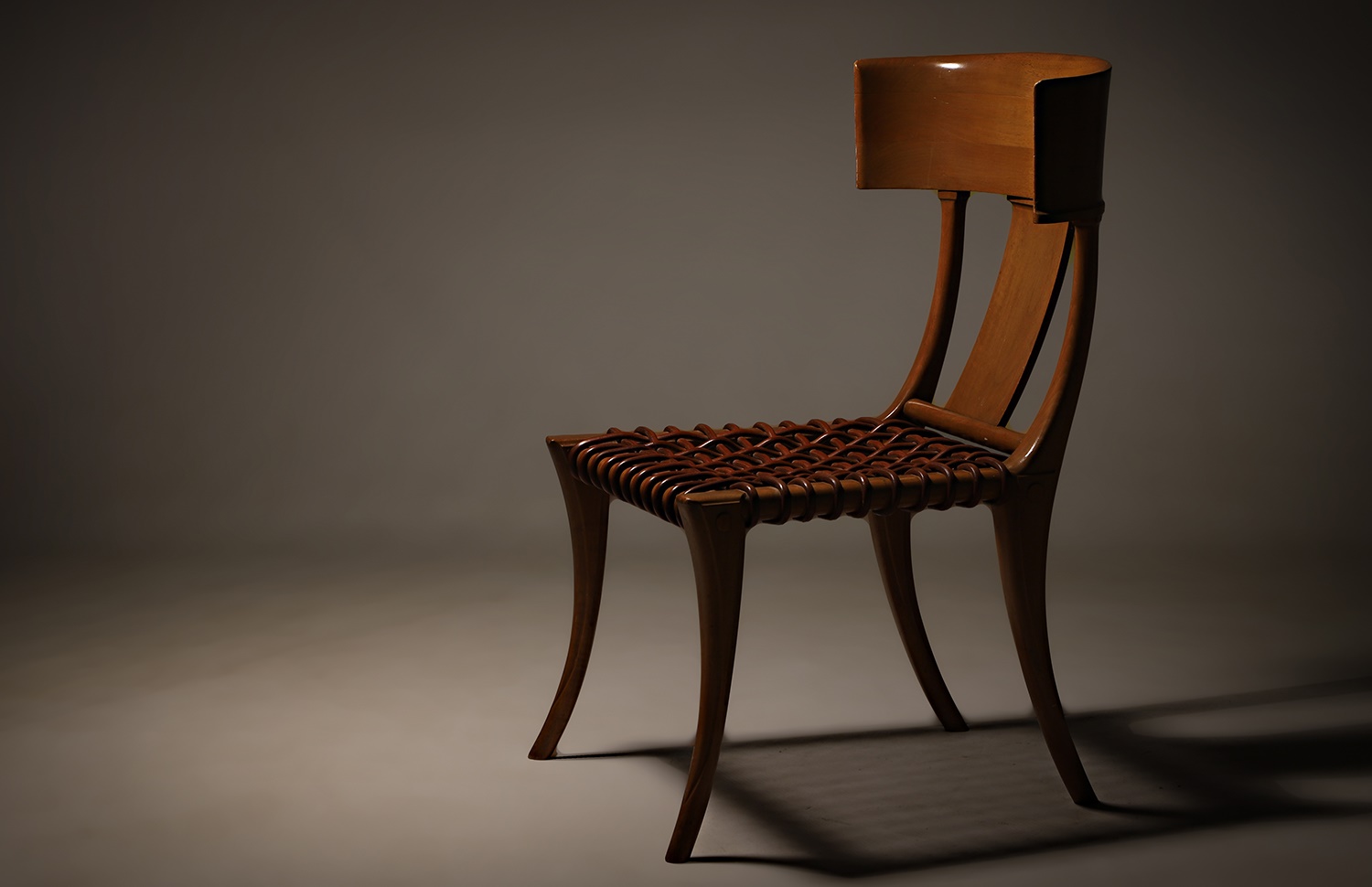
T H Robsjohn-Gibbings (British-American, 1903-1976), a set of four 'Klismos' chairs (£15,000-25,000)
Robsjohn-Gibbings first encountered the klismos during visits to the British Museum in the 1930s. There, he became captivated by a bronze miniature chair decorating the base of a Greek candelabrum. Looking again at painted Greek vases, he suddenly recognised an entire lost world of domestic furniture: “chairs, couches, stools, chests, and tables.” What struck him most profoundly was the vitality of these forms. Unlike the heavy revival styles of the 19th century or the rigid functionalism of modernism, Greek furniture appeared youthful, humane, and timeless.
This discovery would shape the rest of his career. Rejecting both the “lifeless utilitarianism” of modernism and the stale ornament of conventional neoclassicism, Robsjohn-Gibbings pursued a new vision of design grounded in the enduring humanity of classical form.2 In 1936, he introduced handmade klismos replicas in his Madison Avenue showroom in New York, presenting American audiences with furniture that felt simultaneously ancient and strikingly modern.
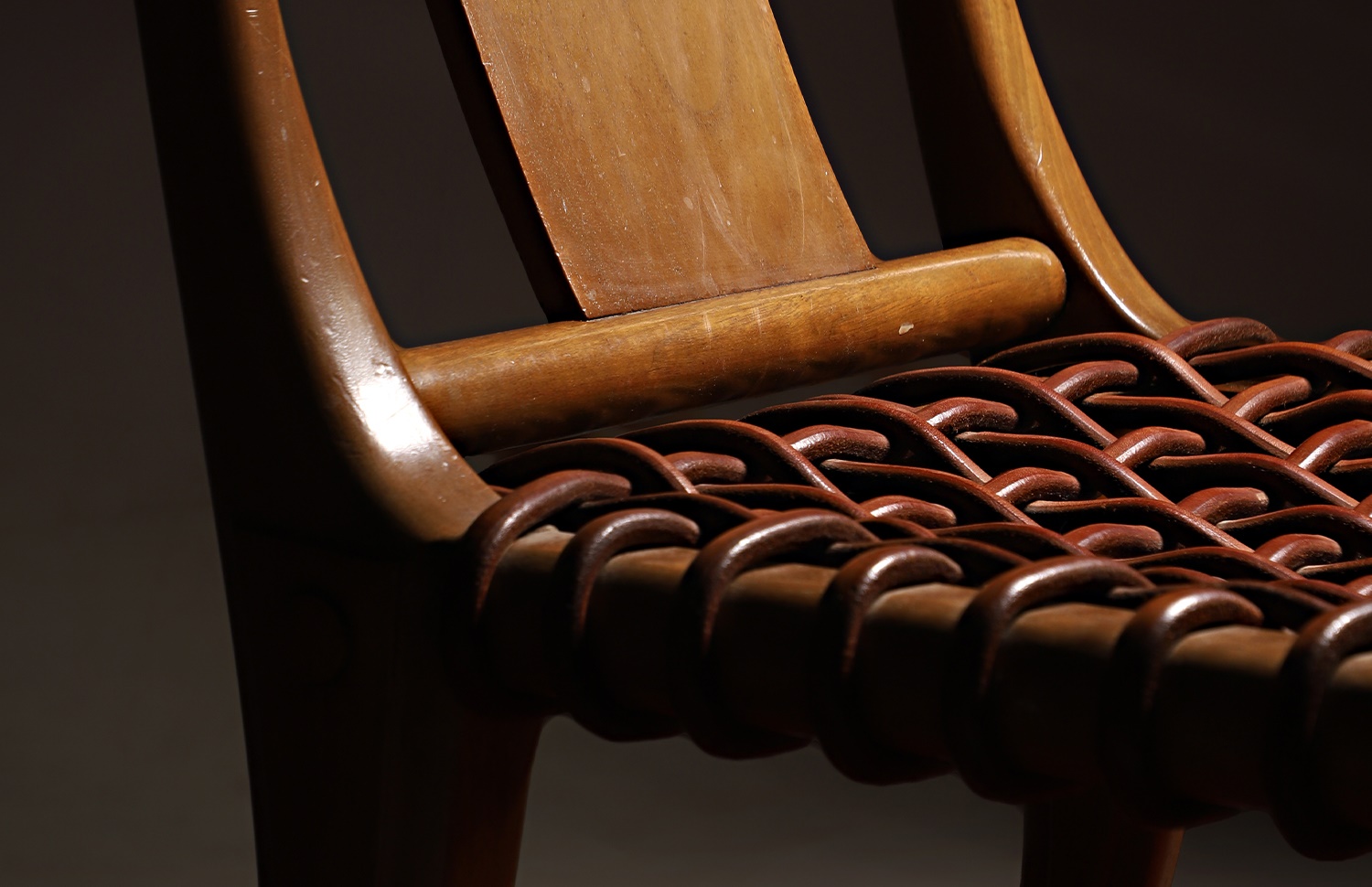
T H Robsjohn-Gibbings (British-American, 1903-1976), a set of four 'Klismos' chairs (£15,000-25,000)
By the 1960s, seeking to manufacture the designs on a greater scale while preserving their integrity, Robsjohn-Gibbings partnered with Saridis of Athens. The workshop possessed both the technical skill and cultural understanding necessary to execute the designs authentically. Together they produced pieces of extraordinary refinement: honey-coloured walnut frames shaped with sculptural precision, woven seats crafted by hand, and proportions carefully calibrated to preserve the grace of the archaeological originals.
Though rooted in antiquity, the Furniture of Classical Greece collection quickly became associated with sophisticated modern living. Its appeal attracted an international clientele drawn to its intellectual restraint and understated elegance. Most famously, Jacqueline Kennedy Onassis selected furniture from the collection for the celebrated “Pink House” on the island of Skorpios, the private retreat owned by Aristotle Onassis. Her endorsement established the collection as a symbol of cultivated cosmopolitan taste, soon attracting admirers including Estée Lauder and Doris Duke.
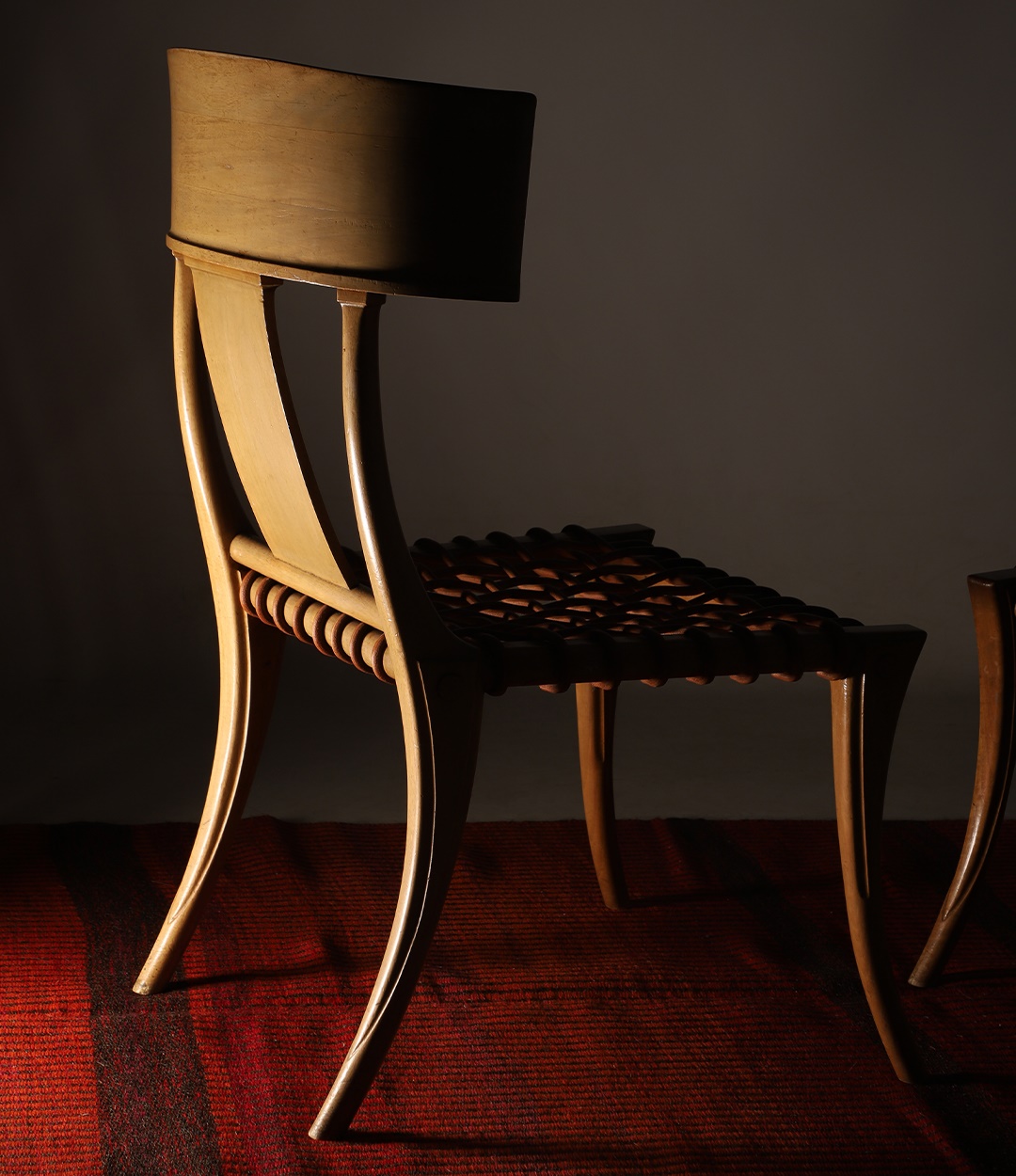
T H Robsjohn-Gibbings (British-American, 1903-1976), a set of four 'Klismos' chairs (£15,000-25,000)
The enduring appeal of the klismos chair lies in its remarkable duality. It is both ancient and modern, archaeological and contemporary. Its sweeping legs and curved back possess an almost sculptural fluidity, while its simplicity allows it to sit effortlessly within interiors of every style. Few reinterpretations have captured this balance as successfully as those produced by Robsjohn-Gibbings and Saridis. More than reproductions, their designs revived the ideals embedded within the original form: harmony, dignity, balance, and humanism.
Preserved together since their acquisition in Athens in 1965, the present set stands as both a superb example of 20th century craftsmanship and a lasting testament to the timeless elegance of classical design.
1Gisela M.A. Richter, Furniture of the Greeks, Etruscans and Romans. New York: Phaidon Press, 1966.
2Robsjohn-Gibbings quoted in “Hello, Mr. Robsjohn-Gibbings,” House and Garden, 91. June 1947, 157.

design@sworder.co.uk | 01279 817778

This summer, Sworders will offer an exceptional set of eight ‘Klismos’ Classical Greek No. 3 chairs, designed by Terence Harold Robsjohn-Gibbings and manufactured by Saridis of Athens. Presented in the 14 July Design auction in two lots of four, the chairs represent one of the 20th century’s most refined reinterpretations of the ancient world.
11 June 2026
Situated in the heart of South Kensington, 18 Thurloe Square forms part of one of London's most distinguished nineteenth-century garden residences, and we are delighted to offer items from this collection in our forthcoming Fine Interiors sale.
8 June 2026
Sworders are extremely fortunate to present a selection of items from the distinguished collection of James Hamilton, 5th Duke of Abercorn.
5 June 2026