
We are delighted to be offering a painting, attributed to George Gower (c.1540-1596) Portrait of a lady, said to be Lady Arabella Stuart, Daughter of Charles, 5th Earl of Lennox in our 25 June sale of Old Master, British & European Art.
23 May 2024
VIEW LOT REQUEST A VALUATION CONTACT A SPECIALIST
George Gower (c.1540-1596) is a painter about whose personal life we know little, but whose professional status as Serjeant Painter to Queen Elizabeth I granted him access to many noble personages of his day. He is notable for his use of complex symbolism, as in his self-portrait where a painter’s tools outweigh his coat of arms in a balance, or in the portrait of Elizabeth I in which she is represented with a sieve in reference to Tuccia, a virginal figure from antiquity.
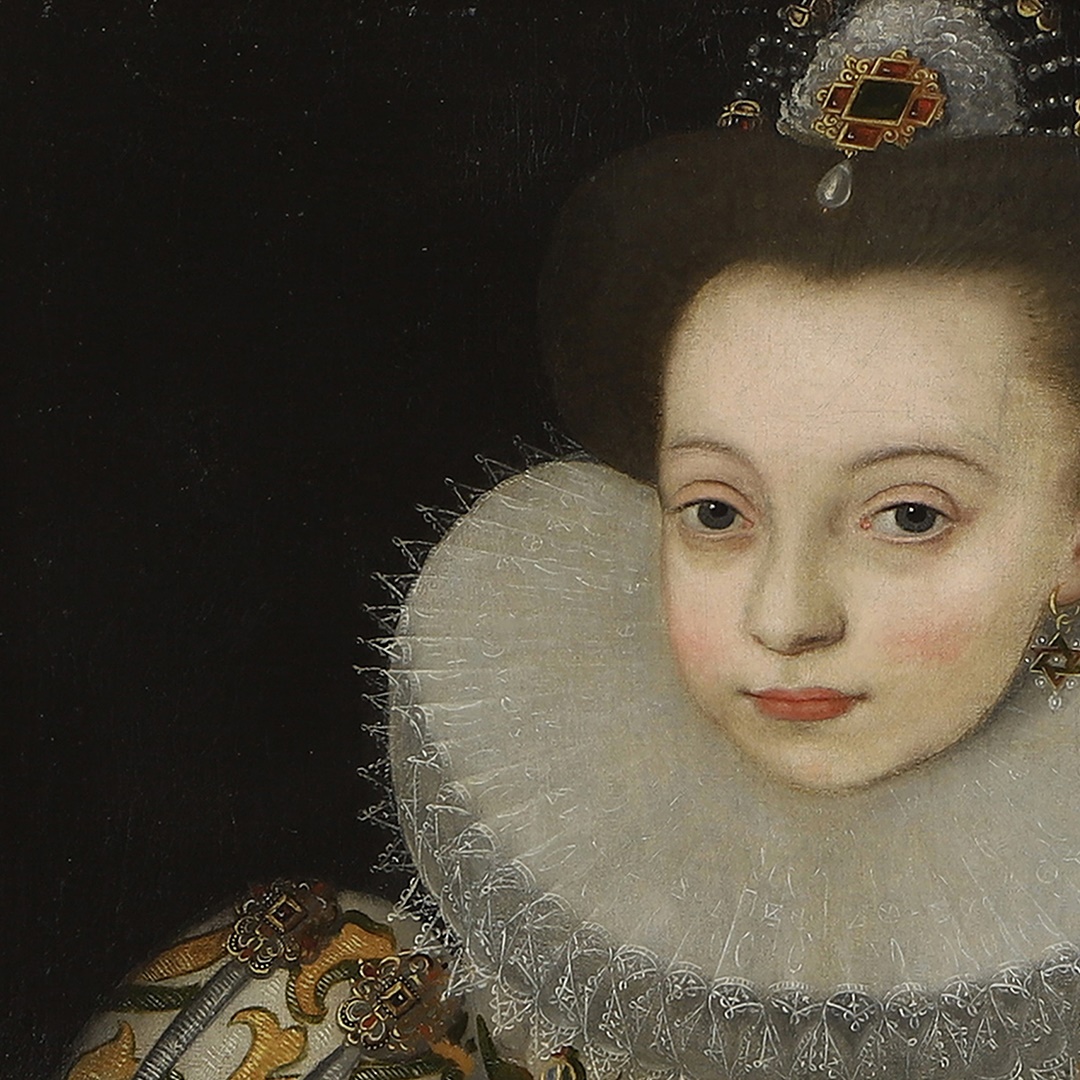
Attributed to George Gower (c.1540-1596) Portrait of a lady, said to be Lady Arabella Stuart, Daughter of Charles, 5th Earl of Lennox, half-length, in a richly embroidered and bejewelled dress with a white lace ruff oil on canvas 64 x 53cm, in an Italian carved giltwood frame (£30,000-40,000)
In this portrait, said to be of Lady Arabella Stuart, one piece of many amongst her jewellery stands out as peculiar. The pendant earring she wears is not a simple pearl, as might be expected, but is rather a device composed of interlocking triangles, closely resembling the Seal of Solomon or Star of David. Such a device also appears in the gold necklace worn by the 23-month-old Arabella in the Hardwick Hall portrait of her. In this portrait of the very young Arabella, she holds a doll which the National Trust argues bears a strong resemblance to the then-Queen, Elizabeth I. Henry VIII, Edward VI, Elizabeth I and James VI/I were often tied to Solomon, including explicitly in speeches given by the monarchs, in contemporary writing, in portraiture and in court masques.
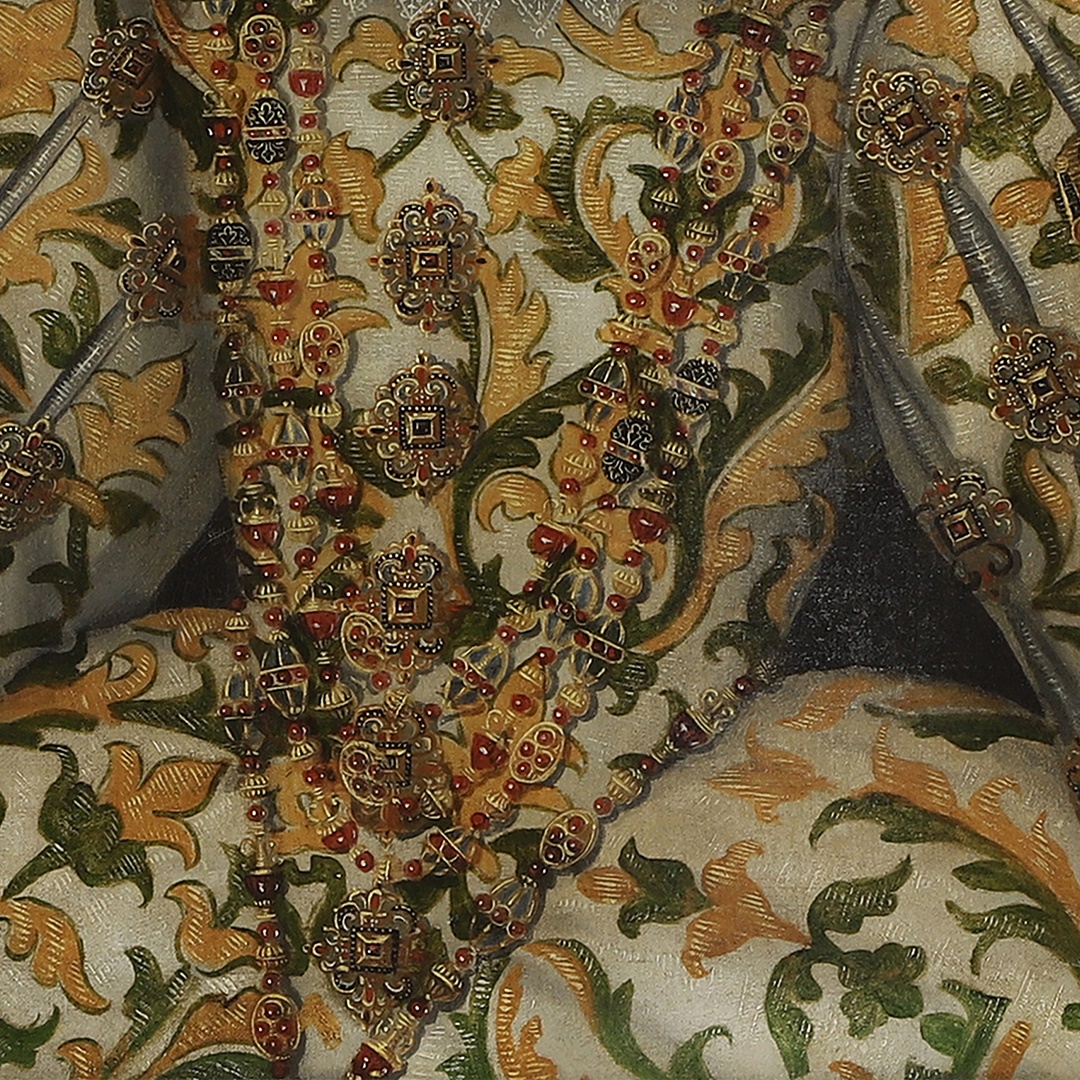
Attributed to George Gower (c.1540-1596) Portrait of a lady, said to be Lady Arabella Stuart, Daughter of Charles, 5th Earl of Lennox, half-length, in a richly embroidered and bejewelled dress with a white lace ruff oil on canvas 64 x 53cm, in an Italian carved giltwood frame (£30,000-40,000)
After the rupture from the Catholic Church, English monarchs sought to underline their status as Solomonic antitypes in an effort to consolidate their ecclesiastical authority. The line in 2 Chronicles 9:8, ‘Blessed be the Lord they God, which loued thee, to set thee on his throne as King, in the steade of the Lorde thy God’, was oft-quoted as an assurance that a monarch could be the direct representation of God on earth, as is brilliantly explored in Victoria Brownlee’s Biblical Readings and Literary Writings in Early Modern England, 1558-1625.
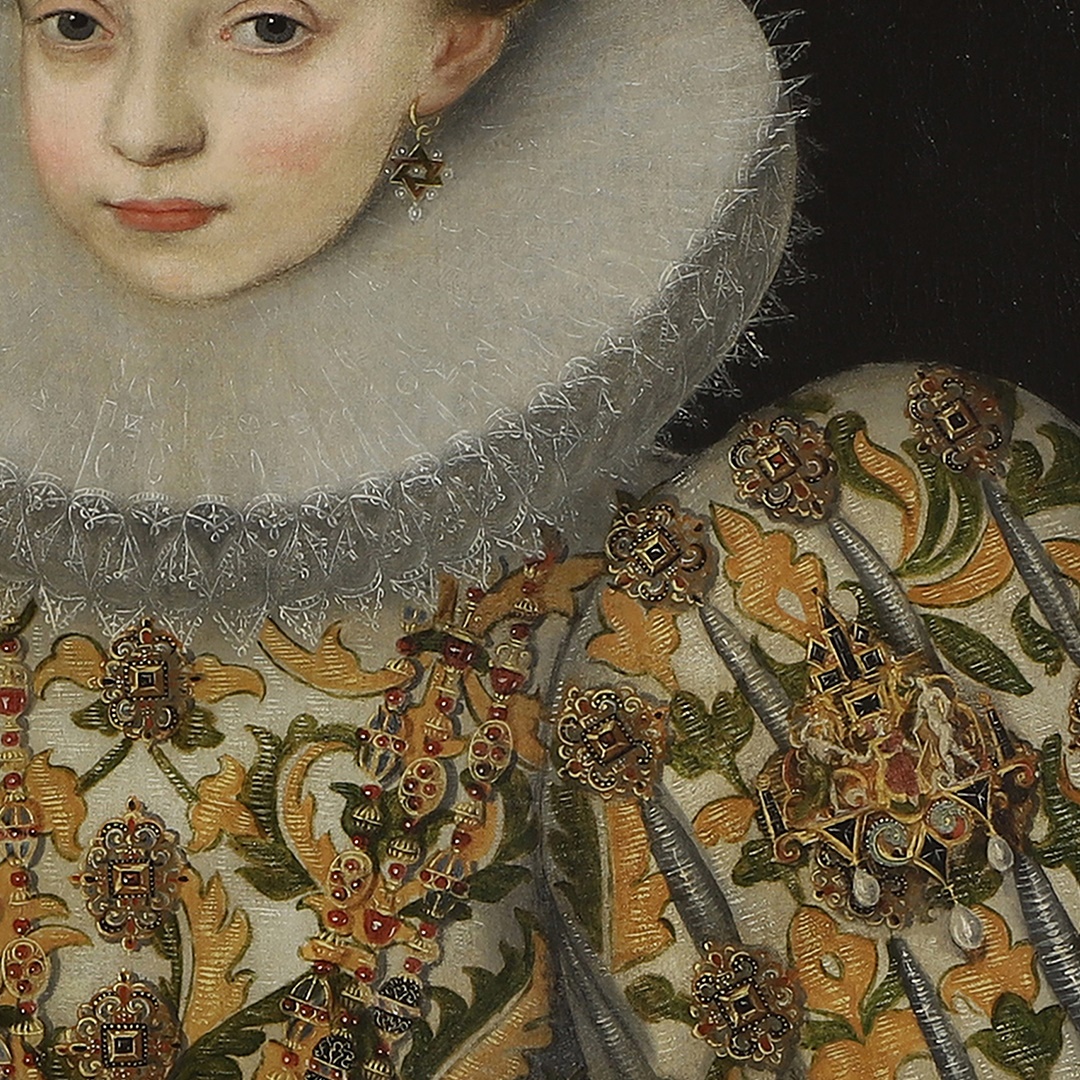
Attributed to George Gower (c.1540-1596) Portrait of a lady, said to be Lady Arabella Stuart, Daughter of Charles, 5th Earl of Lennox, half-length, in a richly embroidered and bejewelled dress with a white lace ruff oil on canvas 64 x 53cm, in an Italian carved giltwood frame (£30,000-40,000)
No such literature exists to tie Arabella herself to these traditions, and yet we find this politically charged symbol in two portraits of the young woman. If Solomon is taken as a symbol of a powerful, unifying ruler in a time of some tumult, then Arabella’s association with him through this symbol might be taken as her assertions towards the throne. She stood to inherit, as James VI did, though she was not chosen. The presence of the symbol in this portrait seems to reinforce the status of its sitter as a hopeful for the throne, and thus to tie it more directly to Lady Arabella.

pictures@sworder.co.uk | 01279 817778

Discover the story behind two rare photographs of Martin Luther King Jr. and Lal Bahadur Shastri, exploring their historic meeting in London, and the significance of the original colour film.
8 September 2026
Through a compelling series of photographs, this exhibition shines a light on The HALO Trust’s work in communities affected by conflict, capturing both the danger of landmine clearance and the hope that follows when land can be safely used again.
3 September 2026
The term ‘Company School’ refers to a genre of painting that emerged in India in the late 18th and 19th centuries, flourishing under the patronage of British East India Company officials, their families, and other European residents in India.
28 August 2026